It’s amazing how many plants are coming up in my garden. Every time I either look outside or go outside to look at the garden I notice how much the plants have grown or new green shoots coming up in areas that were barren the day before.
The monkshood is already making an appearance:
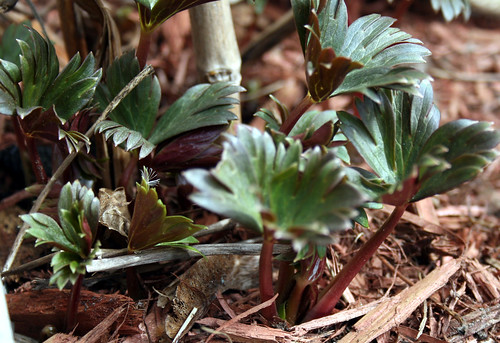
This is Monkshood Aconitum Arendsii Azure Blue.
The new leaves are coming up amid the old stalks that I still have to remove! Usually I tidy up the garden beds in the fall, but I didn’t really do that last year. Even when I clean up the garden in the autumn I’ll often still leave a few plant stalks or a leaf or two so that come spring I can remember where the plant is planted.
I do have plant markers in the garden, but most have been there for four or five years now and they are barely legible or they’ve snapped in the cold so there’s only half of the plants name.
I grow another kind of Monkshood at the back of the garden near the holly shrub. It’s a bicolor Monkshood and I’ve forgotten it’s full name.
Now I know I have several photos of the Azure Blue Monkshood but I can’t find any of them right now. Odd. I do have a photo of the BiColor Monkshood as it’s beginning to bloom though.
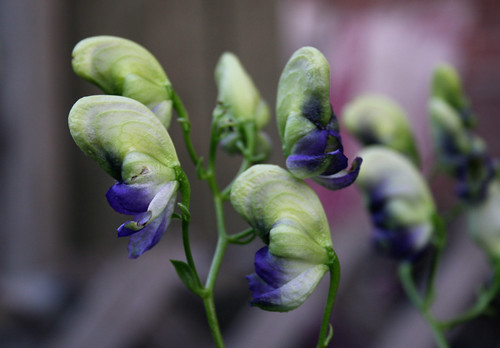
The bicolor Monkshood usually blooms twice a season. Often once in July and then in Mid to Late September. The Azure Blue only blooms once in late August through into September.
Monkshood is very easy to grow, but you must remember that it’s a poisonous plant. I’m a little nervous about growing it now that we have a Labrador Retriever puppy, but I don’t think she’ll be allowed in the backyard very often and certainly not unsupervised.
Monkshood can be grown in shade or bright sunlight. It does best with at least 6 hours of bright sunlight each day. Depending on the species it grow from 30 inches to approx. 36 inches in height.
This plant does best in rich, moist, humusy soil. It doesn’t like being disturbed once it’s established but it can be propagated through division.
There are several species and hybrids of Monkshood. Some will rebloom if the flowers are removed shortly after they’ve finished blooming as with my bicolor monkshood and others are of the fall blooming variety.
Monkshood is a beautiful plant that adds a lovely touch of color to the garden bed. Even it’s foliage is attractive. Just remember that all parts of the plant are poisonous!
Wow, that Monksnood looks like an interesting flower.
I like the leaves, and the way the flower opens from the bottom to the top.
I really love the colour and shape of this flower, very unique. Great photo btw!!