As the Garden Grows

What's blooming today?

  • Home
  • Blog
  • Archives
  • Links
  • About
  • Join GTS Meme
  • Guest Blogger
  • Contact

You are here: Home / Archives for Home and Lifestyle

Stinking brew! Alfalfa Tea

by Tricia

Oh my. I did something this evening that I have to do under the cover of darkness. No, I’m not doing something illegal or trying to hide some big gardening secret from my neighbors.

No, nothing quite as simple as that I’m afraid.

You see, I’m quite sure that my neighbors are well aware that something is going on when I do my sneaky deed.

It’s the smell that gives it away.

Remember sometime near the beginning of July I posted that I was going to brew a batch of Alfalfa tea? Yup, well I did. It brewed and fermented, and I stirred it and tended to it and the herbal grow juice was more than ready to be poured onto my garden beds.

I used two large garbage bins. Added 6 cups of alfalfa pellets to each bin and filled them to within 4 inches of the top. Then I added 1.5 cups of Epsom salt to each container as well. The alfalfa contains a natural growth hormone that the plants respond to very quickly, plus the alfalfa gives them a nitrogen boost too. The epsom salts add some magnesium to the mix. Just for good measure I also added some Iron Green. Read the directions on the bottle to figure out how many capfuls of iron Green to add per litre or gallon of water. I followed the directions but I can’t remember how much I added at this time.

When I was done preparing the mixture I gave it a good stir with a big stick and then put the lids on the containers. I stirred it two or three times a day for most of the last three weeks. It was ready after about one week but we were going through a heat wave here so I wasn’t ready to use it.

Oh, I also added about a cup of molasses to each container on the third day. This feeds the bacteria that is developing and aids in the fermentation process.

It’s very important to stir the mixture at least once a day to add some air into the fluid that brewing away in your driveway, or backyard. If you don’t it will smell even worse when you decide to use it.

But I digress. I stopped to tell you my recipe for alfalfa tea in case you want to try it on your own garden. You might not, by the time I finish my story, but let me testify that it works. No matter how bad it might smell you will get results and you’ll get them very quickly. Honest, I wouldn’t lie to you.

I guess, to my neighbors, this might seem like a big garden secret because I only pour the stuff on my garden late at night when most people are inside their homes. Then they see that my garden is lush and full of new growth on all the plants and that I have lovely blooms on all of my flowering plants.

But I don’t pour it on the garden at night because it’s a secret. No, I’d gladly share my recipes with them. No I do it because it smells terrible. Like a cross between poop and vomit. Really disgusting. Well, this batch was anyways since I’d let it go to long thanks to the heat wave.

I’m sure anyone around can smell it for several blocks.

My husband helped me. He pre-watered the garden beds so the alfalfa tea wouldn’t just roll off the mulch when I poured it around the plants. I, of course, had the nasty job of filling watering containers with the nasty brew splashing myself in the process as I walked back and forth from the flower beds to the brewing containers.

Whenever a bus would go by and stop at the corner we’d try to hide ourselves in case someone walked in the direction of our home. If we saw someone walking down the street and knew they would pass our house we’d stay out of sight then too. The job is so nasty that you just want to get it over with and you don’t want to stop and talk to neighbors inquiring about the awful smell.

Chris went over the areas that I had applied the alfalfa tea to and did a normal watering of the area. This helps soak the alfalfa tea into the ground and, well, it cuts the smell down a lot too.We had to shower when we came in to get the smell off of us, but I think my hands still smell.

I wouldn’t do this if the results were nil to mild. Uh huh, it wouldn’t be worth it. The results are spectacular! I started using alfalfa tea last year. I think the garden got at least four doses of the stinking brew. Within days of each application new growth could be seen on most of the plants. The roses would start to grow basal canes, and other plants would start to push out flower buds.

You’ve seen pictures of my garden on this site, and if you’ve been cruising around you’ve also seen my plants on Tricia’s Musings and Breath of Life, that should be proof that it works and that my garden is healthy. I don’t use any chemicals in my garden. Everything is natural.

If you are daring, and you’d like a lovely garden, take my advice and make some alfalfa tea. It stinks but it works. You’ll love it. Oh yes, you might want to apply it to your garden when your neighbors aren’t around just as I do, otherwise I’m sure those around you will have something to say about it.

More information on alfalfa tea:

Fertilizing roses – Alfalfa Tea

What are the Benefits of Aerated Compost Teas vs. Classic Teas?

Enjoy!


Filed Under: Garden Maintenance, Garden Tips, Home and Lifestyle, Organic, Plant health, The neighborhood Tagged With: aeration, alfafa growth hormone, alfalfa pellets, Alfalfa tea, brew, compost recipe, epsom salt, fast, fermented, flowering plants, garbage bins, garden beds, Garden Tips, grow, growth, healthy plants, Home and Lifestyle, molasses, new growth, Organic, organic fertilizer, Plant health, recipe, smell, smells terrible, stink, stir, water

Raspberries

by Tricia

Did I tell you that I grow raspberries?

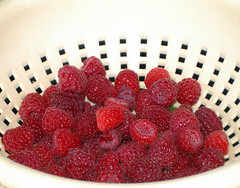
Fresh Raspberries Now doesn’t that look yummy?

The raspberry bushes are one of the few plants left in the yard by the original owners. I’ve changed pretty much everything else. Well, there wasn’t much to begin with, but I knew during that first summer, as I picked a colander full of raspberries almost each day, that the most of the bushes would be staying.

Originally, there had been perhaps more than 50 raspberry bushes in the back right hand corner of the yard. Lovely for the fruity benefits, but not so great when I decided to landscape during the spring of 2002 in order to begin my lovely rose garden. I only left about 15 plants when I created what is now my raised garden beds. In the years since, the plants have started to multiply, and I think there are likely 25 bushes out there.

Growing Raspberries:

Would you like to grow your own raspberries in your yard? Here’s how.

Nothing caps a summer evening better than a raspberry smoothie, or a bowl of fresh raspberries and cream. Ripe berries sprinkled on cereal in the morning is always nice too. Because of their delicious uses and ease of growing, the perennial raspberry ought to be in every garden.

The most commonly grown raspberry is the red, but the purple and black type make interesting variations on the raspberry theme. All can be grown in most zones and they are self fertile. To make the most of your raspberry patch check with your local nursery or county extension to make sure that the variety that you want to buy will thrive in your area.

Planting:

Moisture and plenty of rich organic matter in the soil are essentials. When deciding on a location, look for a spot that gets some protection from the blustery cold winds of winter. To improve the soils ability to retain moisture, work in plenty of well rotted manure or sphagnum peat moss.

Set the bushes in the ground as soon as you bring them home from the nursery. If roots appear dried out, soak them in water for an hour or two before planting. Red raspberries can be planted two or three inches deeper than at the nursery. black and purple varieties should be planted at the same depth. Space plants three feet apart and rows five to eight feet apart. (Needless to say my plants are much closer together than that in my tiny backyard.)

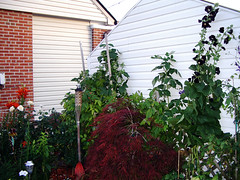
Raspberry bushes My raspberry plants are sheltered behind my neighbors garage. In this photo you can see them beginning at the Japanese Maple with the row going back towards another neighbors house.

Care and Feeding:

After the canes have been set out, cut back central canes to a height of six inches, then mulch to conserve moisture.

When plants are dormant in early spring remove weak and spindly canes. Then remove any suckers that have grown up between the rows. If properly pruned raspberry canes are self supporting. Cut back your black raspberry varieties to 18 to 24 inches; purple and red varieties to 30 to 36 inches. the amount and the quality of the fruit will be greatly improved if lateral branches are trimmed back to at least four to six buds.

In the Autumn remove all old, spent canes and destroy them.

Insects and Diseases:

Raspberries are hardly immune from disease and insect attack, but problems will be few if you practice good garden hygiene. Purchase only healthy disease resistant plants from a trust worthy nursery or garden center.

Make sure that old canes are removed and destroyed so insect larvae and fungus spores don’t overwinter. If a plant appears doomed because of disease, remove it immediately so that the other plants don’t become affected.

Now that you know how to grow your own raspberries I think I’ll go fix myself a small bowl of raspberries. Mmmmm delicious.

Filed Under: Fruit, Health, Organic, Perennials, Plant Profiles Tagged With: care, Fruit, garden, growing, Growing raspberries, Health, Organic, Perennials, Plant Profiles, planting, Raspberries, Raspberry

Creatures of the dark

by Tricia

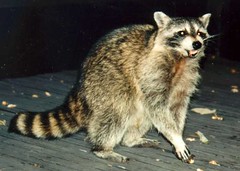
RaccoonMeet my little friend – isn’t he cute?

Right, uh huh …

It seems that this little creature – or one just like him, and I are destined to meet.

I tend to water in the evenings. Yes I know that isn’t always the best thing for garden plants but I really have had few problems develop by doing so. I water in the evening because I live next to two older ladies, uh, elderly ladies and they each come outside and water twice a day.

One in particular tends to follow me around, or worse she waits until I’m as far away from her as I can possibly be, and then she asks me a question or comments on the weather or some such thing.

“Huh, what? I can’t hear you?”

So I stop what I’m doing and walk over to where she is – usually on her porch – and get her to repeat whatever she had said. After a short conversation I try to get back to work, only to be interrupted several times. What should be a half hour job turns into a two hour job because of these ladies and other adjoining neighbors.

Having explained the background, hopefully you can see why I’ve taken to watering in the late evening, and even after dark?

My garden is small, but it’s full of plants, and as a result it can take more than two hours to water it adequately if I only water every second or third day. Most of the plants are in the backyard, therefore most of my time is spent in the back, in the semi-dark, and with the possibility of meeting up with Mr. and or Mrs. Raccoon. Oh and their kids too!

And that is what has been happening lately!

We have a raccoon that seems to think that the backyard is his or hers. It hangs out on the fence between our house and our other neighbors and watches me in the yard. I’m not all that happy with this situation. It’s not always there … sometimes it shows up after I’ve been watering for a while, like last night.

tea-party7 I heard scritch scritch scritch and looked over, and there on top of my neighbors covered patio was the raccoon. He or she was just about to climb onto my fence, and from there who knows where it would have gone. I turned quickly, hose in hand and dialed the nozzle to Jet and sent a stream flying at him! You should have seen him run!

Victory was mine! I felt like one of Charlies Angels with that move. My trusty water hose and nozzle saved the day.

Naturally after that adrenaline rush I was nervous. So much for my victory. It might come back!

So what did I do? No I didn’t stop watering. My garden was thirsty, but I do have to say, it probably didn’t get as much as it would have had the raccoon not made my heart pitter patter. I stood in my yard near the patio, not too far from the porch and safety inside the enclosed back room, and watered from there. I put the hose on a strong but wide stream and hit all the plants in the back corners and back borders. The plants closer to me got a little more accurate watering.

So how do I get the raccoons to stop hanging out in my yard? It’s not like there’s any garbage that they can get into in the back. They dig in a few of my plants now and then but otherwise don’t really cause any damage. Not so bad really … it’s just that I like being outdoors around the same time that they seem to come out and I don’t like meeting them face to face.

They’ve never been around this much. Before they used to just walk through our yard and move onto one of our neighbors yards – used ours like a freeway I guess. But I’ve been sick this year and haven’t been out as much – especially after dark, so I think this has given them a chance to stop and look around and say “Hey, this is a nice place to hang out”.

What’s your thoughts on raccoons hanging out in the backyard? Should I just stop going out there after dark and let them win? Unfortunately, that would mean braving my neighbors attention and everything taking two or three times longer than it should take to get done. Nope … I gotta figure out a way to scare the pesky raccoons away, because my neighbors are worse! Help!

Filed Under: Home and Lifestyle, pests, Pets and Wildlife, The neighborhood Tagged With: backyard, creature, damage, dark, encounter, fence, garden, hang out, hose, jet, meet, neighbor, pest, pests, Raccoon, scared, Toronto, watering

  • « Previous Page
  • 1
  • …
  • 152
  • 153
  • 154
  • 155
  • Next Page »

Subscribe


Never miss a post
Subscribe to our RSS feed!
It's FREE! rss feed

Free Newsletter

As the Garden Grows
by Email - FREE!


Follow me on Twitter!

Suggested Sites

Eavestrough Cleaning Toronto

Categories

Recent Posts

  • Top Three Tips For Choosing The Right Patio Furniture For Your Home
  • The 4 Things To Know About Perennial Garden Design
  • Painful Plants: Five Houseplants That Can Cause Injury
  • An Outbreak Shouldn’t Mean A Break Out: 3 Insect Repellants Gentle Enough For Your Skin
  • 5 Ideas To Make Your Garden POP
  • 6 Simple Ways To Make Your Home Eco-Friendly
  • How To Redesign Your Garden To Make It Safe For Your Children
  • Starting A Career As A Professional Gardener
  • 6 Time Saving Tips For Gardening
  • Top Tips On Redesigning Your Garden For The Summer

What they’re Saying

  • Rodhe Stevens on Landscaping Tips On A Limited Budget
  • Edmund Wells on Benefits of using mulch on the garden
  • Surjith on An Outbreak Shouldn’t Mean A Break Out: 3 Insect Repellants Gentle Enough For Your Skin
  • Pamela on The 4 Things To Know About Perennial Garden Design
  • dog on The quality of your pet food is important

Pages

  • About
  • Archives
  • Become a Guest Blogger For As the Garden Grows
  • Blog
  • Categories
  • Contact
  • Disclosure
  • Do Follow Bloggers Blogroll
  • Green Thumb Sunday
  • I am Canadian Blogroll
  • Join GTS Meme
  • Links
  • Privacy Policy
  • Q & A
  • Toronto Bloggers Blogroll
  • What’s Growing

Search

My Garden

Member of
Garden Voices

Tags

backyard Beautiful bloom blooming blooms Bulbs cold Entertainment and Rec flower flowers garden garden bed garden beds gardener gardening green Green Thumb Green Thumb Sunday grow growing GTS home Home and Lifestyle House In The Garden leaves my garden photo photos plant plants purchase rain rose roses Shopping snow spring summer Toronto water weather winter Wordless Wednesday WW

Site Ratings


Visitors since 2006


Meta

  • Log in
  • Entries feed
  • Comments feed
  • WordPress.org

Connect with me

  • Facebook
  • Google Plus
  • Pintrest
  • Twitter
  • RSS

Copyright © 2026 · News Child Theme on Genesis Framework · WordPress · Log in