You’ve been searching my site, here’s a few answers to your questions:
What do bee balm seeds look like?
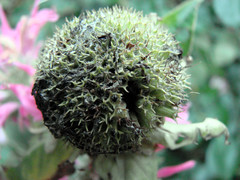 I don’t have a good picture of my own Bee Balm seeds, although I do have a photo of a bee balm seed head.
The seeds are very tiny, as shown on this Great site by the SeedCo.uk . The bee balm seeds are the fourth image in the top row.
Throughout the summer I usually dead head the bee balm flowers that are starting to look a bit raggy. However, near the end of the season, say early September or a bit later, I let some of the blooms dry out and turn into seed heads. Once they get to the stage seen in the photo above I will shake out some of the seeds into a tiny clear plastic bag, label the bag and store it in a cool dry spot in my basement for future use.
I sometimes pluck off the dried seed head and shake some of the seeds out on the ground near the current plant, or in an area in which I’d like to grow a new bee balm plant. Try to remember to label the area in which you planted some seeds if you do this. I scuff a little bit of soil over the seeds and basically forget about them until mid- spring when new plants start coming up. In the spring I weed out new plants so that they aren’t too crowded. Sometimes I even pot some seedlings up and give them to friends who have admired my Bee Balm.
Care instructions for jasmine sambac:
Jasminum sambac is an evergreen shrub, that often reaches 5 ft in height in pots. Called “pikake” in Hawaii,Jasminum Sambac is the plant used to flavor the jasmine tea and making perfumes.
Arabian Jasmine blooms all year long in the greenhouse.
To grow these plants outdoors, you have to be in zone 8 or higher. Jasmines like hot and humid conditions during the day, and cool temperatures at night. Since frost can kill these plants, with care one can successfully grow these as house plants. (I do put my Jasmine Sambuc outdoors in the summer in an area of bright shade. It’s usually outside from mid-June until Mid-September, and it often looses some leaves when I move it from indoors to outdoors and back again.)
Jasminum Sambac can be grown both in full sun (forms a nice bushy shrub when pruned) or in shade (tends to grow more like a vine, leaves get bigger and darker). Perfect container plant. Use great amount of organic matter when planting (leaf mold, peat moss, humus, compost), but soil must be well-drained and evenly moist at the same time. Jasmines do not like soggy conditions.
From spring through fall, fertilize monthly with a balanced fertilizer such as 10-10-10. Tie the stems to supports and keep the soil evenly moist through the growing season. Prune after flowering to keep the plants thinned and shaped. Some branches may reach 6 to 8 ft long. Pruning also helps keep an abundance of flowers, since flowers are produce on new wood.
My Jasmine Sambuc loves it’s water. The plant is approximately 3 feet tall. In the summer when it’s outdoors I water it almost daily, and in the winter I often water it every second or third day. It doesn’t like damp conditions so be careful to make sure that the soil is not damp.
One more tip – If you bring your Jasmine indoors in the winter make sure the room it’s in is not dry. Humidify the air. Dryness brings on spider mites and they will quickly damage your plant and can get out of control easily. Along with regular watering to keep the soil slightly moist, I will often mist my Jasmine with water. If I notice any spider mites starting up I’ll add a drop or two of liquid detergent to my spray bottle and mist the plants leaves and branches with the soapy mixture.
Green Thumb
I’m not sure what the person was searching for with this term. Were you looking for a gardener with a green thumb or perhaps my meme “Green Thumb Sunday”?
I never realized that I had such a green thumb until we purchased our first house five years ago and I started my lovely garden. Yes, I’d had pretty good luck with house plants prior to becoming an outdoor gardener, but the true test was beginning and maintaining my outdoor garden. I haven’t lost too many plants, and the ones that I’ve lost I can mostly blame on either poor initial health when I purchased the plant or to severe winter conditions. I guess I do have a green thumb.
If you have a green thumb, want to have a green thumb or you love taking photos of nature, gardens, plants and landscapes think about joining my meme Green Thumb Sundays. Post a new picture every Sunday and visit other Green Thumb Sunday participants. It’s easy.
If you aren’t a gardener or passionate about nature and lovely landscapes don’t feel left out. You can join one of my blogrolls if you’d like. If you are Canadian you could join the “I am Canadian Blogroll“, and if you are from Toronto you could join the “Toronto Bloggers blogroll“, and if you have a photoblog that you post to regularly you might be interested in joining “Fabulous Photoblogs“. Think about it.
What grows in a dark garden?
Not too much.
However, plenty of things will grow in a shaded garden.
Some of the hardy geraniums are good for shade. There is Geranium phaeum and its many varieties for spring flowers, G. pratense for summer and G. procurrens for fall bloom.
Violets, Primula, Bergenia, Brunnera (giant forget-me-not), Dicentra (bleeding heart), Pulmonaria (lungwort), Epimedium and London Pride bring spring flowers. All of these perennials are available in several forms that offer variations in flower and foliage coloring.
There are perennial foxgloves in yellow, pink and apricot for early summer bloom. Lady’s mantle (Alchemilla mollis) forms highly attractive mounds of serrated, pleated leaves and sprays of greenish yellow flowers that are excellent in fresh cut and dried arrangements. Corydalis lutea, a ferny bleeding heart type perennial, gives yellow flowers all summer.
A pretty ground cover for shade is dead nettle (Lamium), which is available in a variety of different foliage variegations and flower colors. Flowering is from late spring through the summer. Christmas rose and Lenten rose (Helleborus) bring big buttercup-like flowers in winter to early spring, the Christmas rose in white and the Lenten rose in deep plum.
Mainstays of a shaded perennial garden are the feathery astilbes and glamorous-leaved hostas. Both are available in miniature to giant size, and in a wide choice of colors.
While the perennials in a new bed are young and small, plant the spaces between them with summer fill-ins — pansies, impatiens, monkey flower (Mimulus), coleus and begonias. An attractive floral cascade effect could easily be achieved in several spots by setting trailing hanging basket type fuchsias, in their containers, on upended pots to elevate the fuchsias off the ground.
Over time I will discuss the care of a number of the plants mentioned above as well as many more.