As the Garden Grows

What's blooming today?

  • Home
  • Blog
  • Archives
  • Links
  • About
  • Join GTS Meme
  • Guest Blogger
  • Contact

You are here: Home / Archives for Plant Profiles / Perennials

Allium

by Tricia

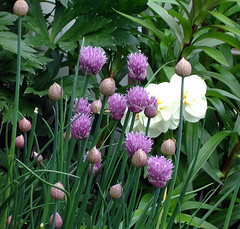
Chives and Daffodil How many of you planted Allium this fall so it will come up next late spring or early summer?

This is a large genus consisting of more than 700 species of bulbous perennials and biennials that occur in temperate regions of the northern hemisphere and range in height from 4 inches to 5 feet (10 cm – 1.5 m).

Some species are edible, including onions, garlic and chives.

The most ornamental species, which are brightly coloured with beautiful flowers, mostly come from west and central Asia.

Common to the genus is the oniony smell emitted when the leaves are bruised or cut. All species have flowers in an umbel terminating on a small, erect stalk and sheathed in bud by membranous bracts.
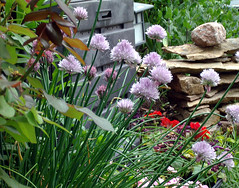
Chive blossoms Bulbs can be fat or quite slender but generally produce new bulbils at the base, sometimes also in the flower stalks.

Cultivation:

They prefer a sunny, open position in fertile, well-drained, weed free soil. Both edible and ornamental species have the same pest and disease enemies such as onion fly, stem eelworm, rust and onion white rot. Propagate from seed or bulbils.



Filed Under: Perennials Tagged With: allium, allium flowers, bulbils, Bulbs, cultivate allium, Perennials, propagate allium

Begonia

by Tricia

1,500 Species of Begonia

Begonias are native to moist tropical and subtropical regions of all continents except Australia, and are most diverse in South America. There are over 1,500 known species, ranging from rhizomatous perennials a few inches high to 10 foot shrubs. Many are grown indoors as house plants, prized either for their beautifully coloured and textured foliage or showy flowers, sometimes both present in the one species or cultivar.

Begonias Mostly evergreen, they have broad, usually asymmetrical leaves or rather brittle and waxy texture. Female flowers, as distinct from male flowers which are on the same plant, have broad, colored flanges on the ovaries which develop into winged fruits.

Begonia enthusiasts divide the species and cultivars into a number of classes depending on growth habit and type of rootstock.

The cane stemmed begonias are erect growers, sometimes quite tall, with straight stems, fibrous roots, and usually pendant clusters of showy flowers; somewhat similar are shrubby begonias, with a more closely branched (the bedding begonias belong here); another similar group but with lower softer stems are known as the winter flowering begonias grown for their profuse and colorful flowers that peak in winter.

The rhizomatous begonias are a larger and varied class, with leave arising directly from creeping knotty rhizomes – they include the Rex begonias with colorfully variegated leaves and many others grown for foliage; and finally there are the tuberous begonias, now largely represented by hybrids of the Tuberhybrida Group: These plants die back to tubers in winter and bear large, showy, often double flowers in summer.

Cultivation:

Many of the cane stemmed, winter flowering, shrubby and rhizomatous types can be grown outdoors in frost free climates and make fine garden plants, though rhizomatous kinds in particular are prone to slug and snail attack. As indoor plants they do well in standard potting mix with peat moss or leafmold added to increase acidity.

Grow in bright to moderate light, with good ventilation and above average humidity, which can be maintained by standing pots on a tray of pebbles and water. Pinch back young plants of the shrubby type to keep them compact and to encourage flowers.

Tuberous begonias require special treatment; tubers must be forced into growth in early spring at a temperature of 65F in peat moss or sphagnum, and kept in a cool, well ventilated green house for the summer flowering season. After flowering plants die back and tubers are lifted in mid-fall and stored dry.

Propagate from tubers in the case of tuberous begonias. Other begonias may be propagated from stem or leaf cutting (layer the cut leaf blades flat on damp sand and weighing them down with pebbles), or by division of rhizomes, or from seed.

Begonias are susceptible to gray mold, powdery mildew and botrytis in the warmer part of the year if conditions are too damp.

Filed Under: Perennials Tagged With: Begonia, cane stemmed, Perennials, rex, rhizomatous, tuber, Tuberhybrida, tuberous

Coral Bells

by Tricia

Heuchera micrantha commonly known as Palace Purple

This is a seed-grown strain, rather than clonal cuttings, so the plants vary wildly. Growing them in light shade seems to protect the foliage from burn, and on some of the superior forms, the flowers make a light, airy effect that is highly appealing.

Palace Purple does not seem as prone to develop woody stems that need to be divided as frequently as some of the other heuchera types, although this varies widely by plant.

This lovely, often purple foliaged plant grows to 12-18 in.. When planting space 24-36 in. Coral Bells are quite hardy, and should thrive in USDA zone 3a – 8b. Coral Bells prefer to be in a shady to partial sunny spot. The blooms that spring up on tall stalks are white or off white.

Coral Bells bloom from late spring to mid Fall, and blooms repeatedly. The folliage is deciduous and should not be covered with mulch in the winter or it may rot. Heuchera has average water needs and should not be over watered.

Propagation can be achived by collecting the seeds from the dried blooms. Sow the seeds indoors before the last frost and plant out in the early spring after the last frost has passed.

Filed Under: Perennials Tagged With: coral bells, heuchera, Palace purple, Perennials, plant, Plant profile, propagation, seeds

  • « Previous Page
  • 1
  • …
  • 14
  • 15
  • 16
  • 17
  • 18
  • …
  • 20
  • Next Page »

Subscribe


Never miss a post
Subscribe to our RSS feed!
It's FREE! rss feed

Free Newsletter

As the Garden Grows
by Email - FREE!


Follow me on Twitter!

Suggested Sites

Eavestrough Cleaning Toronto

Categories

Recent Posts

  • Top Three Tips For Choosing The Right Patio Furniture For Your Home
  • The 4 Things To Know About Perennial Garden Design
  • Painful Plants: Five Houseplants That Can Cause Injury
  • An Outbreak Shouldn’t Mean A Break Out: 3 Insect Repellants Gentle Enough For Your Skin
  • 5 Ideas To Make Your Garden POP
  • 6 Simple Ways To Make Your Home Eco-Friendly
  • How To Redesign Your Garden To Make It Safe For Your Children
  • Starting A Career As A Professional Gardener
  • 6 Time Saving Tips For Gardening
  • Top Tips On Redesigning Your Garden For The Summer

What they’re Saying

  • Rodhe Stevens on Landscaping Tips On A Limited Budget
  • Edmund Wells on Benefits of using mulch on the garden
  • Surjith on An Outbreak Shouldn’t Mean A Break Out: 3 Insect Repellants Gentle Enough For Your Skin
  • Pamela on The 4 Things To Know About Perennial Garden Design
  • dog on The quality of your pet food is important

Pages

  • About
  • Archives
  • Become a Guest Blogger For As the Garden Grows
  • Blog
  • Categories
  • Contact
  • Disclosure
  • Do Follow Bloggers Blogroll
  • Green Thumb Sunday
  • I am Canadian Blogroll
  • Join GTS Meme
  • Links
  • Privacy Policy
  • Q & A
  • Toronto Bloggers Blogroll
  • What’s Growing

Search

My Garden

Member of
Garden Voices

Tags

backyard Beautiful bloom blooming blooms Bulbs cold Entertainment and Rec flower flowers garden garden bed garden beds gardener gardening green Green Thumb Green Thumb Sunday grow growing GTS home Home and Lifestyle House In The Garden leaves my garden photo photos plant plants purchase rain rose roses Shopping snow spring summer Toronto water weather winter Wordless Wednesday WW

Site Ratings


Visitors since 2006


Meta

  • Log in
  • Entries feed
  • Comments feed
  • WordPress.org

Connect with me

  • Facebook
  • Google Plus
  • Pintrest
  • Twitter
  • RSS

Copyright © 2026 · News Child Theme on Genesis Framework · WordPress · Log in