As the Garden Grows

What's blooming today?

  • Home
  • Blog
  • Archives
  • Links
  • About
  • Join GTS Meme
  • Guest Blogger
  • Contact

You are here: Home / Archives for Plant Profiles / Perennials

Growing native Bee Balm

by Tricia

bee-balm_lg

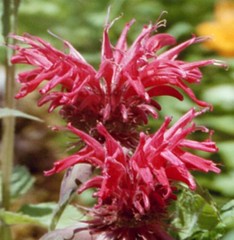
Bee Balm Monarda Didyma

Description:

Striking red flowers that look like Jesters’ hats and last for weeks give this plant a slightly comical air. Its stem is square (characteristic of plants in the mint family) and its leaves are dark green, sometimes flushed with dark red. Quickly growing into a large, tall clump, bee balm is altogether a sturdy, colorful addition to the garden.

Maintenance and requirements:

Although bee balm prefers moist places in the wild, it can be grown in average moisture conditions in the garden.

Versatile in its light requirements, from partial shade to full sun, and also in its PH tolerance, from slightly acidic to neutral (pH 5.5 to 6.5), bee balm is very easy to grow. The only problem you might encounter is mold, which often covers the leaves in a whitish film, signaling that the plant is crowded and not getting enough air movement; divide plants every few years, and don’t spray eaves when watering. Deadhead to extend blooming.

Height: 2-5 feet (60 to 150 cm)

Blooming period: Early to mid-summer

Exposure: Partial shade to full sun

Moisture: Moist to average

Habitat: Moist woods, moist meadows

Range: North East – North America

Propogation:

Bee Balm is easy to start from seeds. Simply sprinkle seeds in pots or a bed in late fall or early spring (seeds do not need cold stratification). Or divide the plant in early spring, which is not only useful for propagation, but also helps keep the plant from getting too crowded in the center.

Good Companions:

At the woodland edge, plant bee balm with black-eyed susan (Rudbeckia hirta) and woodland sunflower (Helianthus divaricatus).

Related Species:

Wild Bergamot (M. Fistulosa)

Wildlife:

Bees, butterflies, and hummingbirds swarm this plant for nectar.

Misc.:

Also known as Oswego tea, because the plants were used by the Oswego Indians for a hot drink. Bruise its aromatic leaves for the scent of Earl Grey Tea.

I grow two of the hybrid species of Bee balm and I love them. Their care is exactly the same as that of the native species that I’ve described above. Enjoy!


Filed Under: Garden Buzz, Garden Tips, In The Garden, Perennials, Questions and Answers Tagged With: Bee Balm, garden, growing, Monarda Didyma, Native plants of North America, Perennials

Annuals and Perennials

by Tricia

What are Annual, Perennial and Biennial plants?

The difference between annuals, biennials and perennials relates to the life cycles of the plants.

Annuals grow from seed to full maturity within one growing season. Marigolds, ageratums, and zinnias are typical annuals. They flower, set seed and die, all within a single year.

Biennials such as Canterbury bells and some foxgloves, complete their life cycles over two years, sometimes producing a few flowers in the first season, but most often just making foliage growth and establishing their root systems.

Perennials live longer than two seasons and may outlive many shrubs. In fact, strictly speaking, shrubs and trees are perennials, but when gardeners talk of perennials they generally mean plants that don’t develop permanent woody stems.

Perennials occur in several types. Some, such as Acanthus, are evergreen and don’t have a period of total dormancy, though few flower continually except in very mild climates.

Herbaceous perennials – those most common in temperate climate gardens – usually have a period of dormancy when they die back to a permanent rootstock. Most commonly this is during winter, but plants from hot dry areas many be dormant in summer or during periods of very low rainfall.

Some herbaceous perennials have developed the ability to use their roots or stems as food storage organs to enable them to survive extended periods of dormancy. Known as rhizomes and tubers, these storage roots can often be separated from the parent plant and grown on as new plants, in much the same way as bulbs and corms. Dahlias and alstroemerias are well-known tuberous plants, while bearded irises are probably the most widely grown rhizomatous plants. Some plants have specialized rhizomes known as stolons, which spread across the surface of the ground, or just below the surface, taking root as they spread.

Some perennials are treated as annuals, either because they cease to be attractive as they age, or because they are incapable of surviving cold winters. Petunias and impatiens, for example, may live for several seasons if protected from frost, but they become leggy and untidy, so they are usually replaced annually.

It is not uncommon for a genus to contain both annual and perennial species, such as the annual and perennial cosmos, or species with differing growth habits, like the fibrous and tuberous rooted irises and begonias.

In cultivation, the differences between annuals, biennials and the various types of perennials tend to become blurred. The important thing is how you use the plants, and with annuals and perennials you can give free rein to your imagination.

Filed Under: Annuals, Perennials, Plant Profiles, Questions and Answers Tagged With: annual, biennial, Bulbs, garden, herbaceous, perennial, plant, Plant Profiles, plants, rhizome, shrubs, tree, tuber

Raspberries

by Tricia

Did I tell you that I grow raspberries?

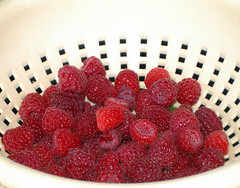
Fresh Raspberries Now doesn’t that look yummy?

The raspberry bushes are one of the few plants left in the yard by the original owners. I’ve changed pretty much everything else. Well, there wasn’t much to begin with, but I knew during that first summer, as I picked a colander full of raspberries almost each day, that the most of the bushes would be staying.

Originally, there had been perhaps more than 50 raspberry bushes in the back right hand corner of the yard. Lovely for the fruity benefits, but not so great when I decided to landscape during the spring of 2002 in order to begin my lovely rose garden. I only left about 15 plants when I created what is now my raised garden beds. In the years since, the plants have started to multiply, and I think there are likely 25 bushes out there.

Growing Raspberries:

Would you like to grow your own raspberries in your yard? Here’s how.

Nothing caps a summer evening better than a raspberry smoothie, or a bowl of fresh raspberries and cream. Ripe berries sprinkled on cereal in the morning is always nice too. Because of their delicious uses and ease of growing, the perennial raspberry ought to be in every garden.

The most commonly grown raspberry is the red, but the purple and black type make interesting variations on the raspberry theme. All can be grown in most zones and they are self fertile. To make the most of your raspberry patch check with your local nursery or county extension to make sure that the variety that you want to buy will thrive in your area.

Planting:

Moisture and plenty of rich organic matter in the soil are essentials. When deciding on a location, look for a spot that gets some protection from the blustery cold winds of winter. To improve the soils ability to retain moisture, work in plenty of well rotted manure or sphagnum peat moss.

Set the bushes in the ground as soon as you bring them home from the nursery. If roots appear dried out, soak them in water for an hour or two before planting. Red raspberries can be planted two or three inches deeper than at the nursery. black and purple varieties should be planted at the same depth. Space plants three feet apart and rows five to eight feet apart. (Needless to say my plants are much closer together than that in my tiny backyard.)

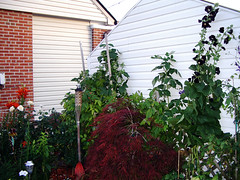
Raspberry bushes My raspberry plants are sheltered behind my neighbors garage. In this photo you can see them beginning at the Japanese Maple with the row going back towards another neighbors house.

Care and Feeding:

After the canes have been set out, cut back central canes to a height of six inches, then mulch to conserve moisture.

When plants are dormant in early spring remove weak and spindly canes. Then remove any suckers that have grown up between the rows. If properly pruned raspberry canes are self supporting. Cut back your black raspberry varieties to 18 to 24 inches; purple and red varieties to 30 to 36 inches. the amount and the quality of the fruit will be greatly improved if lateral branches are trimmed back to at least four to six buds.

In the Autumn remove all old, spent canes and destroy them.

Insects and Diseases:

Raspberries are hardly immune from disease and insect attack, but problems will be few if you practice good garden hygiene. Purchase only healthy disease resistant plants from a trust worthy nursery or garden center.

Make sure that old canes are removed and destroyed so insect larvae and fungus spores don’t overwinter. If a plant appears doomed because of disease, remove it immediately so that the other plants don’t become affected.

Now that you know how to grow your own raspberries I think I’ll go fix myself a small bowl of raspberries. Mmmmm delicious.

Filed Under: Fruit, Health, Organic, Perennials, Plant Profiles Tagged With: care, Fruit, garden, growing, Growing raspberries, Health, Organic, Perennials, Plant Profiles, planting, Raspberries, Raspberry

  • « Previous Page
  • 1
  • …
  • 17
  • 18
  • 19
  • 20
  • Next Page »

Subscribe


Never miss a post
Subscribe to our RSS feed!
It's FREE! rss feed

Free Newsletter

As the Garden Grows
by Email - FREE!


Follow me on Twitter!

Suggested Sites

Eavestrough Cleaning Toronto

Categories

Recent Posts

  • Top Three Tips For Choosing The Right Patio Furniture For Your Home
  • The 4 Things To Know About Perennial Garden Design
  • Painful Plants: Five Houseplants That Can Cause Injury
  • An Outbreak Shouldn’t Mean A Break Out: 3 Insect Repellants Gentle Enough For Your Skin
  • 5 Ideas To Make Your Garden POP
  • 6 Simple Ways To Make Your Home Eco-Friendly
  • How To Redesign Your Garden To Make It Safe For Your Children
  • Starting A Career As A Professional Gardener
  • 6 Time Saving Tips For Gardening
  • Top Tips On Redesigning Your Garden For The Summer

What they’re Saying

  • Rodhe Stevens on Landscaping Tips On A Limited Budget
  • Edmund Wells on Benefits of using mulch on the garden
  • Surjith on An Outbreak Shouldn’t Mean A Break Out: 3 Insect Repellants Gentle Enough For Your Skin
  • Pamela on The 4 Things To Know About Perennial Garden Design
  • dog on The quality of your pet food is important

Pages

  • About
  • Archives
  • Become a Guest Blogger For As the Garden Grows
  • Blog
  • Categories
  • Contact
  • Disclosure
  • Do Follow Bloggers Blogroll
  • Green Thumb Sunday
  • I am Canadian Blogroll
  • Join GTS Meme
  • Links
  • Privacy Policy
  • Q & A
  • Toronto Bloggers Blogroll
  • What’s Growing

Search

My Garden

Member of
Garden Voices

Tags

backyard Beautiful bloom blooming blooms Bulbs cold Entertainment and Rec flower flowers garden garden bed garden beds gardener gardening green Green Thumb Green Thumb Sunday grow growing GTS home Home and Lifestyle House In The Garden leaves my garden photo photos plant plants purchase rain rose roses Shopping snow spring summer Toronto water weather winter Wordless Wednesday WW

Site Ratings


Visitors since 2006


Meta

  • Log in
  • Entries feed
  • Comments feed
  • WordPress.org

Connect with me

  • Facebook
  • Google Plus
  • Pintrest
  • Twitter
  • RSS

Copyright © 2026 · News Child Theme on Genesis Framework · WordPress · Log in