As the Garden Grows

What's blooming today?

  • Home
  • Blog
  • Archives
  • Links
  • About
  • Join GTS Meme
  • Guest Blogger
  • Contact

You are here: Home / Archives for garden design

The 4 Things To Know About Perennial Garden Design

by Trish

Our last hurrah

When it comes to designing are garden it can be difficult to know where to even start. Even if the garden already has a rough layout, it’s difficult to say which plants go where, how they should be planted and what combinations will work.

Over time you’ll develop an instinct for this kind of thing, but here are a few things that you should bear in mind until those instincts kick in.

Make Your Flower Beds Wide

It’s a basic fact of garden design that a skimpy flower bed is nigh on impossible to make look good. Give those beds plenty of breadth, ideally at least a foot of width for every three feet of length. If you’ve got a fifteen foot perennial flower bed it should be at least five feet wide. That said, you don’t want beds any wider than ten to fifteen feet wide, otherwise people will have trouble seeing the flowers at the back of the bed!

Plant Thickly

Do you enjoy looking at dirt? Of course you don’t, nobody does. It’s dirty, it’s brown, it occasionally has worms crawling out of it, it’s not anybody’s idea of an aesthetic treat. So why make the visitors your garden look at it Pack those perennial flower beds so that there is barely an inch of soil visible between them. If there are bare spaces it looks like the plants are too young, or you’re too cheap to get enough plants.

Make Sure the Garden Reflects Your Tastes

Like anyone who does anything creative, a gardener’s work should tell you a little about his or herself. It’s an expression of their tastes and personality. So bear that in mind when planning your garden. Take a look at the surroundings – if you’re creating a garden for a rickety cottage in the Cotswolds, there’s no point trying to go for the same regal atmosphere of a stately home.  But at the same time, always remember, this is your garden, and at the end of the day the first person you need to please is yourself.

Step Back

Gardeners spend an awful lot of our time on hands and knees, barely a nose’s distance away from the ground, working on all the hundreds of tiny details that make up a garden. But every so often it’s worth taking a step back and looking at the garden as a whole. There are essential questions you need to ask yourself about the garden, such as: What is the experience like when you walk through a garden, how do the opposite ends of the garden react to one another when they are  both in your eye line at the same time? Does this look like someone was creating it with a plan or just making it up as they went along? What’s the first emotion you feel as you step through the garden gate?

Getting the answers to these questions right can make the difference between a good gardener and a truly great one.

Featured images:
  •  License: Creative Commons image source

Rob Whitehead is the principal of the Pickard School of garden design.


Filed Under: In The Garden, Perennials Tagged With: bare space, flower beds, garden design, perennial flower, Perennial Garden, Plant Thickly, plants

5 Ideas To Make Your Garden POP

by Trish

All gardens are beautiful, but if you want design features your guests will remember and your family will treasure, you might have to think outside the box. Creativity is the key to making a strong impression. Don’t do anything the way everyone else does it. Try something new. Go with something bold and out of the ordinary and adapt these exciting ideas to your unique style.

1. Add and Aquaponics Water Feature

Water features can be practical as well as beautiful. Consider a working waterfall raining down upon hanging or fixed planters to water them. The planters are filled with grow bed medium and beautiful plants, so your water will stay clean. Finally, after working through a system of numerous planters and waterfalls, the water babbles quietly through a final waterfall into a 300 to 600 gallon decorative fish pond. You could raise Koi for their beauty or Tilapia for your table.

Aquaponics system designs could be natural or something quite modern and abstract. Materials could be stones and concrete, decorative hammered copper and glass or any number of decorative materials. Many people are creating practical aquaponics systems that are utilitarian and designed to grow vegetables and fish, but it is possible to create intense beauty with an aquaponics system as well. Aquaponics systems self water plants, using bell siphons so they require very little maintenance, and the sound of their many waterfalls is absolutely enchanting.

2. Build Matching Walkways, Seating and Planters

There are many methods and materials that can be use to build a wonderland in your garden. Stone is always a good choice, but stamped or decorative concrete can mimic stone, brick, wood, marble or any other surface very convincingly at a fraction of the cost. A good concrete contractor can build both vertical and horizontal surfaces with the same patterns and materials. You will find his fees quite reasonable compared to the price of stone and the entire job will look like it cost a fortune.

3. A Custom Archway Trellis or Arbor with Built In Planters

Trellises and arbors can be so beautiful, but it takes forever for plants in the ground to reach the top of the trellis. Why not design an arbor with planters along the sides and built into the top for flowering plants. By combining the idea of vertical gardening with the old fashioned arched trellis one can have an amazing look almost immediately instead of having to wait for vines to grow to eight feet high? This way all types of flowering plants could be incorporated easily.

4. Build planters on the Top of your Garden Fences

Why not attach long planters to the tops of your fence posts so that they sit on top of the fence in a uniform row. This will add height, not only to your fence but to your garden. You and your guests will be able to enjoy your tall garden as a row of flowers or greenery at a new and unexpected height. This idea would work with any fence height including tall privacy fences. Consider filling the new fence planters with native violets and allowing them to trail down the fence in ample cascades of mauve and white blossoms and deep green foliage.

5. Consider an Exciting Designer Hammock

There are two stunning hanging furniture designs by Dedon, an Italian furniture company. Either would provide a stunning impression. Dedon makes an exciting 2 meter wide hanging teardrop shaped pod made of woven Dedon Fiber and stuffed with exciting outdoor cushions. Another possibility might be their Swingrest daybed. This round garden bed can be suspended or its swivel Corian base can be placed on the ground.

Mike Smith is a home decorator who uses Premium Pools and Gardens for all of his outdoor needs.

Filed Under: Garden Maintenance, In The Garden, Landscaping Tagged With: arbor, archway, creativity, garden design, garden fences, Garden POP, hammock, ideas, impression, planter, planters, plants, seating, trellis, walkway, waterfall

Making a Raised-Bed Garden

by Tricia

Back in 2002 when we landscaped our yard and started our garden we decided to create a raised bed garden.

We decided on raised bed gardening for a number of reason. The main reason being the soil in our yard seemed to be composed of mostly sand and clay. It was dry and difficult to dig deeper than 6 inches or so. amending the soil to a suitable consistency would have taken too long.

patio4 Raised garden beds are easy to build. They are also easy to plant new plants in, weed and maintain.

Other advantages of raised bed gardening that we considered before creating our garden were the fact that the soil would drain quickly in the spring when the snow melts, and the beds would warm up a little faster in the spring as well enabling us to either plant earlier in the season or giving the perennials and shrubs a head start.

So how can you make your own raised beds?

– We used easy wall garden stones (you can read the details of how we landscaped our garden here), but you can create your raised garden bed walls with:

– Concrete blocks, bricks, rocks, natural rot-resistant wood or wood that’s been treated with a safe preservative.

You might also need:

  • Sheet plastic and or a wood preservative if you create wood borders.
  • Measuring tape
  • Shovel
  • Spading fork
  • Rake
  • Hammer
  • Nails
  • Topsoil
  • Compost

Since our raised garden beds were meant to be permanent garden structures we also used gravel screening at the base of the easy wall stones to give the stones a good foundation and also to aid in drainage from the garden beds.

Temporary Raised Beds

If you’re still landscaping and trying to decide where you want to place your garden beds you might consider creating temporary raised garden beds. You can easily change your garden design each season using temporary raised garden beds.

All you really need to do to create a temporary raised bed is shovel garden soil into the area that you’ve planned for your raised bed. You might consider using Triple mix soil as it’s been blended with garden soil, topsoil and compost. Otherwise you can amend your garden spoil by adding top soil and compost to the mix yourself.

Permanent and temporary beds can be shaped in any way that you wish. You can create rectangular, curved, or even round beds.

The basics of building a raised garden bed is that it should be about 12 inches deep and usually no more than three to four feet wide.

Our beds are build around the edges of the garden so we only have access to each bed from one side, however you might think of making a round bed in the center of your lawn or placing two raised beds side by side with two to three feet of space between them for easy access. You’ll be able to access the garden beds from both sides so it will be even easier to care for than ours!

Be sure to remove any rocks, sticks or other debris from the garden bed as you create it. Rake the top of the bed smooth and flat when you are finished building up the soil.

Permanent raised garden beds:

When creating permanent raised garden beds you should use rot-resistant wood (cedar for example) or bricks, rocks, stones or cement blocks. As I said above your bed should be at least a foot deep and no more than three to four feet wide.

If you choose to use a rot resistant wood when creating your raised garden bed you might want to use an earth friendly preservative such as linseed oil or a borax based treatment to slow the rotting of the wood.

Raised beds can be build on the soil of your yard, but I’d recommend loosening the soil with a spading fork or shovel first.

Once you’ve completed building the walls of your raised beds fill with triple mix or top soil, garden soil and compost.

Planting Raised Beds

Now that you’ve created your raised beds you’ll be able to visualize how your garden will look when the beds are planted.

Depending upon what kind of garden you’ve planned you can plant vegetables, herbs or flowering plants in your raised beds.

As my regular readers know our raised beds have a mix of roses (over 60); shrubs – boxwood, Rose of Sharon, Rhododendron, and Azaleas; perennials – lavender, bee balm, saliva, Maltese cross, peonies and many more; and spring flowering plants and bulbs. We also grow tomatoes, carrots, peppers, herbs and leafy greens right in our raised beds along side the flowering plants. The mix of plants actually look quite nice together.

Most of your planting should be done during the spring and autumn months.

You might want to add some fertilizer to the soil around your new plants when you first plant them. We use natural fertilizers such as alfalfa pellets or brew some alfalfa tea or compost tea to use as fertilizer.

If you’ve built your raised garden beds along the perimeter of your yard or fence you’ll want to plant taller plants at the back of the raised beds and shorter plants near the front. If your raised bed is in the center of your yard you’ll likely want to plant the taller plants in the center/middle of the raised bed and surround them with shorter plants.

Just be sure not to compact the soil as you work in your raised beds planting your new plants.

Be sure to water your raised beds regularly. One of the cons of raised beds is that they dry out a little faster than other garden beds.

Every year, usually at the end of May or beginning of June we add some mulch to the garden beds.

We don’t do this earlier in the season as we like to turn the soil around the plants a little bit prior to adding mulch. turning the soil tends to keep slugs at bay. Perhaps their eggs die when exposed on top of the soil. Mulch too early and you might find your garden full of slugs.

Adding mulch to your garden beds adds organic material that will break down over time and help fertilize your soil. The seasonal benefit of mulching is of course that it helps conserve water by keeping the soil moist below the mulch and of course a layer of mulch two or three inches deep will keep weeds away too.

Use straw, shredded bark, shredded leaves or other materials for mulch.

Tips

As I said earlier we have a number of plants in our raised garden beds. I put some thought into what kind of plants I would grow so that I would pretty much have continuous blooms in my garden from late March to November and sometimes even early December.

A variety of bulbs and spring plants work well for early to late Spring. Choose some plants that bloom early and some that bloom later in the season.

Many of the spring blooming plants die down once the weather starts to warm up so they are planted near perennials and rose shrubs. So once they die down, the perennials appear or the roses begin to bloom and the space that the spring plants took in the garden is quickly filled by the growing perennials.

If you grow vegetables in the garden you can arrange to grow them in succession as well. Lettuce often does best in the spring or at least before the weather begins to get quite hot. Once your lettuce is done you might plant beans or another crop of vegetable that isn’t mature until late summer.

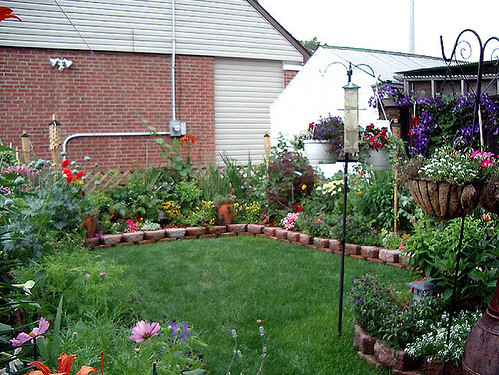
This is what our backyard looked like in July 2003 – just a little more than a year after we’d put in the raised garden beds –

wideview2

Believe it or not, the garden is even fuller now as the plants have reached maturity. It’s beautiful and even more amazing that we did it ourselves.

You can do – get inspired!

Filed Under: Garden Maintenance, Garden Tips, In The Garden, Landscaping Tagged With: Alfalfa tea, Azaleas, backyard, Beds, Bee Balm, bloom, blooming, blooms, boxwood, bricks, building, Bulbs, compost, conserve water, dig, easy wall, fertilizer, flower, garden, garden bed, garden beds, garden design, gardening, gravel, grow, grow vegetables, growing, landscape, Landscaping, maintain, Maltese cross, mulch, Organic, peonies, perennial, Perennials, permanent raised garden bed, plant, planted, planting, plants, raised beds, raised garden bed, raised garden beds, rake, rectangular, rose, Rose of Sharon, screening, shovel, shrub, slugs, snow, spring, spring flower, temporary raised garden beds, tips, tomato, Topsoil, warm, weed, weeds

  • 1
  • 2
  • Next Page »

Subscribe


Never miss a post
Subscribe to our RSS feed!
It's FREE! rss feed

Free Newsletter

As the Garden Grows
by Email - FREE!


Follow me on Twitter!

Suggested Sites

Eavestrough Cleaning Toronto

Categories

Recent Posts

  • Top Three Tips For Choosing The Right Patio Furniture For Your Home
  • The 4 Things To Know About Perennial Garden Design
  • Painful Plants: Five Houseplants That Can Cause Injury
  • An Outbreak Shouldn’t Mean A Break Out: 3 Insect Repellants Gentle Enough For Your Skin
  • 5 Ideas To Make Your Garden POP
  • 6 Simple Ways To Make Your Home Eco-Friendly
  • How To Redesign Your Garden To Make It Safe For Your Children
  • Starting A Career As A Professional Gardener
  • 6 Time Saving Tips For Gardening
  • Top Tips On Redesigning Your Garden For The Summer

What they’re Saying

  • Rodhe Stevens on Landscaping Tips On A Limited Budget
  • Edmund Wells on Benefits of using mulch on the garden
  • Surjith on An Outbreak Shouldn’t Mean A Break Out: 3 Insect Repellants Gentle Enough For Your Skin
  • Pamela on The 4 Things To Know About Perennial Garden Design
  • dog on The quality of your pet food is important

Pages

  • About
  • Archives
  • Become a Guest Blogger For As the Garden Grows
  • Blog
  • Categories
  • Contact
  • Disclosure
  • Do Follow Bloggers Blogroll
  • Green Thumb Sunday
  • I am Canadian Blogroll
  • Join GTS Meme
  • Links
  • Privacy Policy
  • Q & A
  • Toronto Bloggers Blogroll
  • What’s Growing

Search

My Garden

Member of
Garden Voices

Tags

backyard Beautiful bloom blooming blooms Bulbs cold Entertainment and Rec flower flowers garden garden bed garden beds gardener gardening green Green Thumb Green Thumb Sunday grow growing GTS home Home and Lifestyle House In The Garden leaves my garden photo photos plant plants purchase rain rose roses Shopping snow spring summer Toronto water weather winter Wordless Wednesday WW

Site Ratings


Visitors since 2006


Meta

  • Log in
  • Entries feed
  • Comments feed
  • WordPress.org

Connect with me

  • Facebook
  • Google Plus
  • Pintrest
  • Twitter
  • RSS

Copyright © 2026 · News Child Theme on Genesis Framework · WordPress · Log in