As the Garden Grows

What's blooming today?

  • Home
  • Blog
  • Archives
  • Links
  • About
  • Join GTS Meme
  • Guest Blogger
  • Contact

You are here: Home / Archives for Garden Maintenance

New Years Resolutions for Gardeners

by Tricia

Happy New year everyone! I hope that you all have a fantastic year!

When we thinking of making New Years resolutions it’s usually something about ourselves, such as, to be a better person, to lose weight, to quit smoking and so on, but do we ever resolve to take better care of our gardens? I don’t think so.

Since I wasn’t feeling very well this past year I wasn’t out in my garden as much as I was in past years. Usually I’m out there every day – dead heading, trimming, adding organics to the soil and so on. I really fell off this fall when I didn’t even put my garden to bed for the winter. Yes, this year it is totally without winter protection. It should be interesting to see what happens come Spring time.

So in the New Year, I’ve decided to try to follow these great tips from the Plant Doctors at The American Phytopathological Society – perhaps you will too:

  • Mulch my perennials after the ground freezes to help them overwinter comfortably even though temperatures may fluctuate.
  • When studying plant catalogs, look for pest- and disease-resistant plants, such as mildew-resistant phlox, Fusarium-resistant tomatoes and disease-resistant crabapples that will make my gardening job easier and keep my plants healthier.
  • Send a soil sample to a laboratory to learn what my lime and fertilizer needs are, rather than guessing.
  • Set plants in the ground only at the proper depth-deep planting harms roots and kills plants!
  • Use only the well-drained areas of my garden for plants-unless I purchase some swamp-loving species!
  • Inspect plants carefully before purchasing to find evidence of invaders such as spider mites, scale insects or mealybugs, or root swellings that might mean crown gall disease on plants such as flowering cherries or roses.
  • Spread a circle of mulch around young trees to keep lawn mowers from damaging the bark, leading to canker diseases later on.
  • Use only a few inches depth of mulch and keep it a few inches away from trunks and stems of plants to discourage crown rot.
  • Scout regularly for symptoms in the garden, so that I can pick off the occasional spotted leaf before problems escalate.
  • Irrigate new trees and shrubs the first two years especially during dry weather to help them establish good root systems.
  • Use a soaker hose or some type of irrigation system for the flower beds and vegetable garden that won’t wet the foliage and encourage leaf spots.
  • Obtain a diagnosis when the cause of a problem is unclear or needs identification.
  • Prune only in dry weather, especially when pruning plants prone to fire blight, such as pears, crabapples and hawthorns.
  • Encourage beneficial insects and mites by minimizing use of broad- spectrum insecticides.
  • Join a Master Gardener class to learn more about the fun of growing and maintaining plants.

To the New Year and better gardens for all.


Filed Under: Garden Maintenance, Garden Tips, Home and Lifestyle Tagged With: garden, garden advice, Garden Maintenance, Garden Tips, gardening, Gardening resolution, Home and Lifestyle, New Year, Resolution

Gardening tips for you! Part 1

by Tricia

Organic Gardening Tips

1. Mulch your flower beds and trees with 3″ of organic material – it conserves water, adds humus and nutrients, and discourages weeds. It gives your beds a nice, finished appearance.

2. Mulch acid-loving plants with a thick layer of pine needles each fall. As the needles decompose, they will deposit their acid in the soil.

3. The most important step in pest management is to maintain healthy soil. It produces healthy plants, which are better able to withstand disease and insect damage.

4. Aphids? Spray infested stems, leaves, and buds with a very dilute soapy water, then clear water. It works even on the heaviest infestation.

5. Compost improves soil structure, texture, and aeration, and increases the soil’s water holding capacity. It also promotes soil fertility and stimulates healthy root development.

6. Look for natural and organic alternatives to chemical fertilizers, such as the use of compost. Our use of inorganic fertilizer is causing a toxic buildup of chemicals in our soil and drinking water.

7. When buying plants for your landscape, select well-adapted plant types for your soil, temperature range, and sun or shade exposure.

8. Landscaping your yard is the only home improvement that can return up to 200% of your original investment.

9. Plant trees! They increase in value as they grow and save energy and money by shading our houses in the summer, and letting the sun shine through for warmth in the winter.

10. Think of trees and their locations as the walls and roofs of our outdoor rooms, when you are planning their locations and sizes.

11. Grass won’t grow? Find an appropriate ground cover for the exposed earth and fill the problem space, creating an interesting bed shape.

12. Plant vines on walls, fences, and overhead structures for quick shade, vertical softening, and colorful flower displays.

13. If gourmet cooking is in your plans, organically grown herbs make wonderful landscape plants. They flavor foods, provide medicinal properties, and offer up fragrances. And most thrive on neglect.

14. Shade gardens are low maintenance – they require less watering, slower growth, and fewer weeds to fight.

15. Everyone loves flowers! Annuals are useful for a splash of one-season color. But since replacing them each year is expensive, concentrate them in just a few spots.

16. There is no need to work the soil deeply when adding compost or soil amendments. Eighty five percent of a plant’s roots are found in the top 6″ of soil.

17. The best organic matter for bed preparation is compost made from anything that was once alive, for example leaves, kitchen waste, and grass clippings.

18. Dig an ugly hole when planting a tree or shrub. A hole with “glazed” sides from a shovel will restrict root penetration into the surrounding soil.

19. Planting from plastic containers? Carefully remove the plant and tear the outside roots if they have grown solidly against the container.

20. Think of mulching as “maintaining the forest floor”: add 1″ to 3″ of compost or mulch to planting beds each year.

21. Natural fertilizers, compost and organic materials encourage native earthworms. Earthworms are nature’s tillers and soil conditioners, and manufacture great fertilizer.

22. Bare soil should not be visible around a new planting. Always cover with a layer of mulch, any coarse-textured, loose organic material.

23. Think “biodiversity”. Using many different kinds of plants encourage many different kinds of beneficial insects to take up residence in your yard.

24. Organic pest control is a comprehensive approach instead of a chemical approach. Create a healthy biodiversity so that the insects and microbes will control themselves. Using natural products and building healthy soil is the best long-term treatment for pests.

25. Weeds? Spot-spray with common full-strength household vinegar, on a sunny day. It’s an organic weed killer that’s safe for you and the environment.

Stay tuned for part two!

Filed Under: Garden Maintenance, Garden Tips, Home and Lifestyle, Organic, pests Tagged With: Garden Maintenance, Garden Tips, Home and Lifestyle, Organic, pests

Recent Search Terms #2

by Tricia

You’ve been searching my site, here’s a few answers to your questions:

What do bee balm seeds look like?

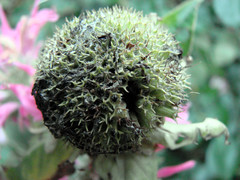
Bee Balm Seed Head I don’t have a good picture of my own Bee Balm seeds, although I do have a photo of a bee balm seed head.

The seeds are very tiny, as shown on this Great site by the SeedCo.uk . The bee balm seeds are the fourth image in the top row.

Throughout the summer I usually dead head the bee balm flowers that are starting to look a bit raggy. However, near the end of the season, say early September or a bit later, I let some of the blooms dry out and turn into seed heads. Once they get to the stage seen in the photo above I will shake out some of the seeds into a tiny clear plastic bag, label the bag and store it in a cool dry spot in my basement for future use.

I sometimes pluck off the dried seed head and shake some of the seeds out on the ground near the current plant, or in an area in which I’d like to grow a new bee balm plant. Try to remember to label the area in which you planted some seeds if you do this. I scuff a little bit of soil over the seeds and basically forget about them until mid- spring when new plants start coming up. In the spring I weed out new plants so that they aren’t too crowded. Sometimes I even pot some seedlings up and give them to friends who have admired my Bee Balm.

Care instructions for jasmine sambac:

Jasminum sambac is an evergreen shrub, that often reaches 5 ft in height in pots. Called “pikake” in Hawaii,Jasminum Sambac is the plant used to flavor the jasmine tea and making perfumes.

Arabian Jasmine blooms all year long in the greenhouse.

To grow these plants outdoors, you have to be in zone 8 or higher. Jasmines like hot and humid conditions during the day, and cool temperatures at night. Since frost can kill these plants, with care one can successfully grow these as house plants. (I do put my Jasmine Sambuc outdoors in the summer in an area of bright shade. It’s usually outside from mid-June until Mid-September, and it often looses some leaves when I move it from indoors to outdoors and back again.)

Jasminum Sambac can be grown both in full sun (forms a nice bushy shrub when pruned) or in shade (tends to grow more like a vine, leaves get bigger and darker). Perfect container plant. Use great amount of organic matter when planting (leaf mold, peat moss, humus, compost), but soil must be well-drained and evenly moist at the same time. Jasmines do not like soggy conditions.

From spring through fall, fertilize monthly with a balanced fertilizer such as 10-10-10. Tie the stems to supports and keep the soil evenly moist through the growing season. Prune after flowering to keep the plants thinned and shaped. Some branches may reach 6 to 8 ft long. Pruning also helps keep an abundance of flowers, since flowers are produce on new wood.

My Jasmine Sambuc loves it’s water. The plant is approximately 3 feet tall. In the summer when it’s outdoors I water it almost daily, and in the winter I often water it every second or third day. It doesn’t like damp conditions so be careful to make sure that the soil is not damp.

One more tip – If you bring your Jasmine indoors in the winter make sure the room it’s in is not dry. Humidify the air. Dryness brings on spider mites and they will quickly damage your plant and can get out of control easily. Along with regular watering to keep the soil slightly moist, I will often mist my Jasmine with water. If I notice any spider mites starting up I’ll add a drop or two of liquid detergent to my spray bottle and mist the plants leaves and branches with the soapy mixture.

Green Thumb

I’m not sure what the person was searching for with this term. Were you looking for a gardener with a green thumb or perhaps my meme “Green Thumb Sunday”?

I never realized that I had such a green thumb until we purchased our first house five years ago and I started my lovely garden. Yes, I’d had pretty good luck with house plants prior to becoming an outdoor gardener, but the true test was beginning and maintaining my outdoor garden. I haven’t lost too many plants, and the ones that I’ve lost I can mostly blame on either poor initial health when I purchased the plant or to severe winter conditions. I guess I do have a green thumb.

If you have a green thumb, want to have a green thumb or you love taking photos of nature, gardens, plants and landscapes think about joining my meme Green Thumb Sundays. Post a new picture every Sunday and visit other Green Thumb Sunday participants. It’s easy.

If you aren’t a gardener or passionate about nature and lovely landscapes don’t feel left out. You can join one of my blogrolls if you’d like. If you are Canadian you could join the “I am Canadian Blogroll“, and if you are from Toronto you could join the “Toronto Bloggers blogroll“, and if you have a photoblog that you post to regularly you might be interested in joining “Fabulous Photoblogs“. Think about it.

What grows in a dark garden?

Not too much.

However, plenty of things will grow in a shaded garden.

Some of the hardy geraniums are good for shade. There is Geranium phaeum and its many varieties for spring flowers, G. pratense for summer and G. procurrens for fall bloom.

Violets, Primula, Bergenia, Brunnera (giant forget-me-not), Dicentra (bleeding heart), Pulmonaria (lungwort), Epimedium and London Pride bring spring flowers. All of these perennials are available in several forms that offer variations in flower and foliage coloring.

There are perennial foxgloves in yellow, pink and apricot for early summer bloom. Lady’s mantle (Alchemilla mollis) forms highly attractive mounds of serrated, pleated leaves and sprays of greenish yellow flowers that are excellent in fresh cut and dried arrangements. Corydalis lutea, a ferny bleeding heart type perennial, gives yellow flowers all summer.

A pretty ground cover for shade is dead nettle (Lamium), which is available in a variety of different foliage variegations and flower colors. Flowering is from late spring through the summer. Christmas rose and Lenten rose (Helleborus) bring big buttercup-like flowers in winter to early spring, the Christmas rose in white and the Lenten rose in deep plum.

Mainstays of a shaded perennial garden are the feathery astilbes and glamorous-leaved hostas. Both are available in miniature to giant size, and in a wide choice of colors.

While the perennials in a new bed are young and small, plant the spaces between them with summer fill-ins — pansies, impatiens, monkey flower (Mimulus), coleus and begonias. An attractive floral cascade effect could easily be achieved in several spots by setting trailing hanging basket type fuchsias, in their containers, on upended pots to elevate the fuchsias off the ground.

Over time I will discuss the care of a number of the plants mentioned above as well as many more.

Filed Under: Garden Maintenance, Garden Tips, House Plants, Photography, Plant Profiles, Recreation, Web and Technology Tagged With: bee balm seeds, Entertainment and Rec, Garden Maintenance, Garden Tips, Green Thumb, House Plants, jamine Sambuc, Photography, Plant Profiles, search terms, Shaded garden, shady garden, Web and Technology

  • « Previous Page
  • 1
  • 2
  • 3
  • 4

Subscribe


Never miss a post
Subscribe to our RSS feed!
It's FREE! rss feed

Free Newsletter

As the Garden Grows
by Email - FREE!


Follow me on Twitter!

Suggested Sites

Eavestrough Cleaning Toronto

Categories

Recent Posts

  • Top Three Tips For Choosing The Right Patio Furniture For Your Home
  • The 4 Things To Know About Perennial Garden Design
  • Painful Plants: Five Houseplants That Can Cause Injury
  • An Outbreak Shouldn’t Mean A Break Out: 3 Insect Repellants Gentle Enough For Your Skin
  • 5 Ideas To Make Your Garden POP
  • 6 Simple Ways To Make Your Home Eco-Friendly
  • How To Redesign Your Garden To Make It Safe For Your Children
  • Starting A Career As A Professional Gardener
  • 6 Time Saving Tips For Gardening
  • Top Tips On Redesigning Your Garden For The Summer

What they’re Saying

  • Rodhe Stevens on Landscaping Tips On A Limited Budget
  • Edmund Wells on Benefits of using mulch on the garden
  • Surjith on An Outbreak Shouldn’t Mean A Break Out: 3 Insect Repellants Gentle Enough For Your Skin
  • Pamela on The 4 Things To Know About Perennial Garden Design
  • dog on The quality of your pet food is important

Pages

  • About
  • Archives
  • Become a Guest Blogger For As the Garden Grows
  • Blog
  • Categories
  • Contact
  • Disclosure
  • Do Follow Bloggers Blogroll
  • Green Thumb Sunday
  • I am Canadian Blogroll
  • Join GTS Meme
  • Links
  • Privacy Policy
  • Q & A
  • Toronto Bloggers Blogroll
  • What’s Growing

Search

My Garden

Member of
Garden Voices

Tags

backyard Beautiful bloom blooming blooms Bulbs cold Entertainment and Rec flower flowers garden garden bed garden beds gardener gardening green Green Thumb Green Thumb Sunday grow growing GTS home Home and Lifestyle House In The Garden leaves my garden photo photos plant plants purchase rain rose roses Shopping snow spring summer Toronto water weather winter Wordless Wednesday WW

Site Ratings


Visitors since 2006


Meta

  • Log in
  • Entries feed
  • Comments feed
  • WordPress.org

Connect with me

  • Facebook
  • Google Plus
  • Pintrest
  • Twitter
  • RSS

Copyright © 2026 · News Child Theme on Genesis Framework · WordPress · Log in