As the Garden Grows

What's blooming today?

  • Home
  • Blog
  • Archives
  • Links
  • About
  • Join GTS Meme
  • Guest Blogger
  • Contact

You are here: Home / Archives for infestation

Japanese Beetles damaging the garden

by Tricia

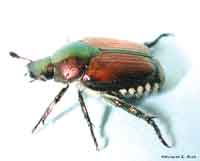
japanese_beetle_adult.jpg I always thought that Japanese beetle infestations were at their worst in July. Why then, are they suddenly attacking some of my roses in August?

I’ve luckily never had too much trouble with Japanese beetles. Only a few here and there each year, whereas I hear from some gardeners that their roses and other plants are partially destroyed after a heavy infestation of the dreaded Japanese Beetles.

These nasty bugs only seem to be attacking a few of my roses. They love my Morden Sunrise in my front flower bed, and in the backyard they seem to be attacking William Baffin, Jacques Cartier, Climbing Iceberg, Baronne Prevost and Compte de Chambord. Considering how many roses I grow that’s not too bad, however these are some of my biggest roses so the damage is stating to become quite visible.

If your garden has never been attacked by Japanese beetles consider yourself lucky.

Adult Japanese beetles are 3/8 inch long metallic green beetles with hard, copper-brown wing covers. Five small white tufts project from under the wing covers on each side, and a sixth pair at the tip of the abdomen. These white tufts help to distinguish them from similar metallic green or coppery colored beetles.

Adults emerge from the ground in late May or early June. Individual beetles live about 30 to 45 days with activity concentrated over a four to six week period. Beetle numbers begin to decline in late July but some can be found as late as September.

I wonder if our cool June and rainy wet July delayed their emergence here in the Toronto area?

Japanese beetles can feed on about 300 species of plants, ranging from roses to poison ivy. Odor and location in direct sun seem to be very important factors in plant selection. The beetles usually feed in groups, starting at the top of a plant and working downward. While a single beetle doesn’t eat much; group feeding by many causes severe damage. Adults feed on the upper surface of foliage, chewing out tissue between the veins. This gives the leaf a characteristic skeletonized appearance.

I’ve also found that Japanese beetles seem to like eating rose buds and newly blooming roses.

If you don’t have too heavy an infestation of Japanese Beetles I’ve found that the best way of controlling them seems to be literally picking them off the plants and dropping them into a bucket of soapy water where they will drown.

The application of Milky Spore to the soil each year will also eventually kill off the larvae and make the likelihood of an infestation much lower.

There are pesticides that you can use if you have a heavy infestation in your garden. I prefer not to use chemicals in my garden because they often do more damage than good. I garden organically and I’ve found that dealing with pests can be quite challenging in an organic garden. I’m glad that there are always alternatives to using chemicals.

Traps can be used to attract and collect beetles however research conducted at the University of Kentucky has shown that the traps attract many more beetles than are actually caught. Consequently, susceptible plants along the flight path of the beetles and in the vicinity of traps are likely to suffer much more damage than if no traps are used at all. In most landscape situations, use of Japanese beetle traps probably will do more harm than good. If you experiment with traps, be sure to place them well away from gardens and landscape plants.

In previous years I’ve grown Four O’Clocks (Marvel of Peru) beside several of my rose bushes and it’s said that Japanese beetles do not like this plant. Perhaps that’s why I’ve never had much trouble with the darn shiny bugs. I planted my Four O’clock seeds late this year though so the plants likely aren’t mature enough to discourage the beetles.

I also used to grow garlic near my roses as that was said to help ward off Japanese beetles. I don’t grow garlic anymore as I always forgot to pick it!

Have your plants ever been attacked by Japanese Beetles? Have you seen any Japanese beetles this year? How have you handled beetle infestations?


Filed Under: Garden Maintenance, Garden Tips, Living Green, Organic, pests, Summer in the Garden, Toronto Tagged With: activity, alternatives to chemicals, attacking plants, august, beetle, beetle traps, bucket of soapy water, damage, damaged roses, eat leaves, eating roses, emergence, flower, garden organically, grow four oclocks, grow garlic, hand pick, hand pick beetles from plants, infestation, infestations, Japanese Beetles, landscape, location, milky spore, Odor, organic garden, pesticides, Poison, rainy, roses, shiny beetles, skeletonized leaves, soapy water, tip, Toronto, traps, ward off beetles

Insects on bearded iris leaves

by Tricia

A visitor to As the garden grows told me that they’d seen some tiny red bugs on their bearded Iris leaves. Blasting the plant with water didn’t help because the bugs came back out again once the leaves dried off.

Spraying the plants with a blast of water was actually a good move and it can be helpful with many types of insect infestations. The insects that she saw were probably aphids. They love new growth on plants and you’ll often find them on tender young leaves or flower buds. They suck the plants juices and can get unsightly if they aren’t controlled.

Aphids breed quite quickly. If you have plants that are infested by aphids you should give them a blast of water daily. You might also add a drop or two of dishwashing liquid to a spray bottle and spray the areas of the plant that are heavily infested. The soap will smother the aphids.

Whatever you do you do not want to kill any ladybugs. Ladybugs love eating aphids and they are beneficial insects in your garden. So, if you use the soapy water method try to watch where you are spraying and avoid hitting any ladybugs.

Filed Under: Garden Tips, pests, Plant health Tagged With: aphids, beneficial insects, bud, buds, flower, garden, infestation, insect, Iris, ladybugs, new growth, water

Controlling house plant pests

by Tricia

In many parts of North America and other areas of the world gardeners have traded their backyard gardening for indoor houseplant gardening. Bringing some plants in from outdoors, and tending to others that are indoors all year round.

Every home owner who keeps houseplants will encounter, at one time or another the dreaded house plant pests. Little bugs that you can often barely see that start to suck on the leaves or burrow into the stems and cause parts of the plant or the leaves to die. If measures aren’t taken to eradicate these pests quickly a whole plant could die.

There are only five major groups of insect and mite pests on house plants, they are very difficult to control and highly persistent, once established. Not only that- but many types of house plants re sensitive to pesticides when they are used on them, plus pesticides used indoors can be quite dangerous to the home owner, small children and household pets.

The three steps to controlling pests are:

Step 1 . Know how to recognize at least the major insect and mite pests that attack foliage plants: aphids, mealybugs, scale insects, whiteflies, and spider mites.

Step 2. Prevent the introduction of pests into the home or existing plant specimen arrangements:
a) buy or propagate only pest-free plants;
b) keep new plants separated from other plants for 4 to 6 weeks to see if any pest problems develop;
c) carefully inspect all plants at least weekly for signs of insects and mites.

Step 3. If a plant is found to be infested with insects or mites:
a) isolate the plant from other plants;
b) correctly identify the pest;
c) determine and apply appropriate control measures;
d) keep the plant separate from others until all evidence of infestation is eliminated, which may be several weeks or more.

Take Control

There are three popular general methods for treating house plants infestations: physically removing the pests and or washing the plant, general purpose ready to use sprays, and chemical concentrates for preparing spray mixtures.

Physical removal is easy enough for large pests- slugs, caterpillars etc.. Pests can also be swabbed with a small brush or cotton tipped applicator moistened with rubbing alcohol.

You may also opt to rinse or wash plants with a diluted mix of dish detergent soap or an insecticidal soap. Sometimes just placing a plant in your shower stall and gently spraying them with lukewarm water on the tops and undersides of the leaves is enough to rid the plant of an infestation, plus give it a good drink and flush it’s substrate at the same time.

Often the soap sprays or rinses need to be repeated over a period of time to totally rid the plant of pests. I also try to isolate plants that I find are infested – I’ll move them several feet away from uninfected plants at the very least, and often into a totally different room if it’s possible. There’s nothing worse than having several plants infested with pests at the same time.

In your garden centres you’ll find ready to use sprays, but if you go searching for one of these types of sprays make sure it’s labeled that it’s safe for use on house plants. Always read the labels and precautions on any of the ready made sprays that you are planning on using as some sprays are effective only for certain types of insects, while others are only effective when the pests are in certain stages of life.

Whiteflies are very difficult to control with standard sprays, but easily controlled with other sprays that are made specifically for whiteflies. Be sure to follow directions. There are many individual products on the market; be sure to read the label to determine which one to use.

Chemical concentrations are available to mix with water for application with a hand sprayer or mister. Insecticides and/or miticides are available separately or in mixtures. Generally insecticides will not control mites, and miticides will not control insects. Only the appropriate pesticide is needed. The wrong one will not be effective.

Another way to prevent infestations in the first place is to care for the plant properly. Many people end up having white fly and mite infestations on their plants in the winter time. The air is dry in the house and the plants are not kept moist enough. Misting the plants with water sprays a couple times of day or keeping the room they are in adequately humidified should help lower the chance of pest infestations in some plants.

Filed Under: House Plants Tagged With: backyard, bed, caterpillar, control pests, foliage, garden, gardener, gardeners, gardening, home, House, house plant, House Plants, houseplant, humid, humidity, infestation, insect, insecticidal soap, insecticide, leaves, mite, North America, outdoor, outdoors, plants, problems, slug, white fly, whiteflies


Subscribe


Never miss a post
Subscribe to our RSS feed!
It's FREE! rss feed

Free Newsletter

As the Garden Grows
by Email - FREE!


Follow me on Twitter!

Suggested Sites

Eavestrough Cleaning Toronto

Categories

Recent Posts

  • Top Three Tips For Choosing The Right Patio Furniture For Your Home
  • The 4 Things To Know About Perennial Garden Design
  • Painful Plants: Five Houseplants That Can Cause Injury
  • An Outbreak Shouldn’t Mean A Break Out: 3 Insect Repellants Gentle Enough For Your Skin
  • 5 Ideas To Make Your Garden POP
  • 6 Simple Ways To Make Your Home Eco-Friendly
  • How To Redesign Your Garden To Make It Safe For Your Children
  • Starting A Career As A Professional Gardener
  • 6 Time Saving Tips For Gardening
  • Top Tips On Redesigning Your Garden For The Summer

What they’re Saying

  • Rodhe Stevens on Landscaping Tips On A Limited Budget
  • Edmund Wells on Benefits of using mulch on the garden
  • Surjith on An Outbreak Shouldn’t Mean A Break Out: 3 Insect Repellants Gentle Enough For Your Skin
  • Pamela on The 4 Things To Know About Perennial Garden Design
  • dog on The quality of your pet food is important

Pages

  • About
  • Archives
  • Become a Guest Blogger For As the Garden Grows
  • Blog
  • Categories
  • Contact
  • Disclosure
  • Do Follow Bloggers Blogroll
  • Green Thumb Sunday
  • I am Canadian Blogroll
  • Join GTS Meme
  • Links
  • Privacy Policy
  • Q & A
  • Toronto Bloggers Blogroll
  • What’s Growing

Search

My Garden

Member of
Garden Voices

Tags

backyard Beautiful bloom blooming blooms Bulbs cold Entertainment and Rec flower flowers garden garden bed garden beds gardener gardening green Green Thumb Green Thumb Sunday grow growing GTS home Home and Lifestyle House In The Garden leaves my garden photo photos plant plants purchase rain rose roses Shopping snow spring summer Toronto water weather winter Wordless Wednesday WW

Site Ratings


Visitors since 2006


Meta

  • Log in
  • Entries feed
  • Comments feed
  • WordPress.org

Connect with me

  • Facebook
  • Google Plus
  • Pintrest
  • Twitter
  • RSS

Copyright © 2026 · News Child Theme on Genesis Framework · WordPress · Log in