As the Garden Grows

What's blooming today?

  • Home
  • Blog
  • Archives
  • Links
  • About
  • Join GTS Meme
  • Guest Blogger
  • Contact

You are here: Home / Archives for landscape

Three Steps to a Fungi-Free Garden

by Trish

If you love gardening, there is nothing more frustrating than seeing all your time and effort go to waste due to fungi attacking your greens and blooms. To make matters worse, these culprits spread rapidly when conditions are favorable and eventually cause a wide variety of parasitic diseases on plants.


However, plant fungal diseases are usually the result of some factors that you can actually control. In fact, as simple as paying attention to your garden’s hygiene and cleanliness can do a whole lot in protecting your plants against fungi attacks. Written below are three more ways you could follow to keep damaging fungi at bay.

Mind your plant placement

Remember that fungi thrive well in damp conditions and planting your greens too close together will eventually result to crowding, which limits the amount of air circulating between the plants. When this happens, your greens are not able to shed water well, especially on their leaves. And if left unattended, fungal spores that are carried by air easily attach themselves on leaf surfaces, thereby setting the stage for fungal invasion.

To avoid this, it is vital that you site your plants properly to allow optimal air circulation around them. It is also wise to group plants together base on their level of water needs so that when you create an irrigation system, you will be able to apply the same amount of water to specific plants within your garden.

Ensure good landscape sanitation

As mentioned earlier, the key to keeping your garden free from fungal diseases is to observe cleanliness. Hence, if you have greens or blooms that are susceptible to fungal diseases, make sure that you regularly remove and discard leaf trimmings, old root systems and fallen fruits from their growing area to avoid the onset of fungi attack. If, for instance, you will reuse old pots, sterilize them before you put the greens in to minimize the risk of fungi infecting the plants.

Practice preventive measures

Keeping your plants in tip-top condition by properly attending to their needs is your safest bet to ensure that they will be able to withstand fungi attacks. Therefore, when gardening, don’t forget to practice preventive measures such as watering the plants’ bases instead of their leaves, applying fresh mulch every now and then to prevent spores from bouncing on the surfaces of leaves, and applying compost to keep both your soil and plants healthy.

Additionally, use horticultural oils and baking soda solutions to keep fungal diseases from infecting your plants in the first place. And don’t forget to provide your greens and blooms with optimum growing conditions (sufficient light, water and soil) so that they will grow healthily.

This gardening advice was penned by one of the regular contributors of Heritage Cleaning, a stone cleaning specialist in Scotland. Their steam-based stone cleaning system is acknowledged by Historic Scotland and has been used in the restoration and conservation of listed buildings throughout the country.


Filed Under: Garden Maintenance Tagged With: air circulation, baking soda, blooms, control, damp conditions, frustrating, fungal disease, fungi, fungi free, garden, gardening, horticultural oil, landscape, leaf trimming, plant placement, preventative, protect plants, roots, thrive, weeding

How to Enjoy Your Garden in the Winter

by Trish

With the winter approaching, the bitter cold and darkening nights may see you spending more time indoors, neglecting your garden until the spring comes around again. But it doesn’t have to be that way! There are plenty of ways to enjoy your garden in the winter, so chuck on your boots, don your woolly hat, and venture out into the cold to enjoy a few of these enchanting treats…

Stargazing

There’s no better time than the crisp, clear nights of winter to gaze up to the sky and take in its breath-taking beauty. The Milky Way will sparkle brightly, the moon will beam more than you’ve ever known, and if you gaze for long enough you’re sure to see a shooting star or two. Wrap your arms around a loved one or your hands around a mug of hot cocoa while you gaze, mesmerised by what the night sky has to offer.

Bonfires & Fireworks

There’s no cosy a feeling as standing around a roaring bonfire with your close friends and family, sharing jokes and reminiscing over good times. Make a night of it and get a little merry, procure a folding table to rest your drinks upon, toast a few marshmallows on the fire, and finish the night off with a spectacular fireworks display.

Festive Decorations

The long nights can make your garden seem an unappealing, hard place. The flowers wither, the trees lose their leaves and the animals go into hibernation – but that doesn’t mean your garden can’t be a place of joy. Breathe life back into it with some seasonal decorations, string up a row of fairy lights and be filled with merriment every time you glance outside.

Year-Round Decorations

It’s not just festive decorations that can liven up your garden during the cold, winter months. Incorporate ornaments and evergreens into the landscape of your garden so that when the autumn begins its slow march into winter, your garden will remain vibrant and appealing. Build rock walls and paths, and place boulders and sculptures throughout to add a charm that lasts throughout the year.

Snow!

Everybody hopes for snow come winter, and our wishes usually come true, even if only briefly. As soon as the first flakes start to fall, put on your wellies and your winter coat, and prepare for some jovial frolicking! Build snowmen and snow-dogs, and snow-whatever-elses-you-fancy. Start a snowball fight with the mischievous neighbours, and when you’re tired out from that, collapse to the ground and carve out some snow angels!

As you can see, there are plenty of ways to enjoy your garden in the winter – and these are only a smattering of possibilities! Use your imagination and you’re sure to come up with countless excuses to get out the house, instead of whiling away your days in front of the television, waiting for the sun to return.

Bill Weston writes on a number of subjects including gardening furniture such as folding tables. You can find a folding table at http://www.gopak.co.uk/

Filed Under: Garden Tips, In The Garden Tagged With: bonfires, cold, enjoy, festive decorations, fire, garden, joy, landscape, lights, marshmallows, ornaments, seasonal, winter

Japanese Beetles damaging the garden

by Tricia

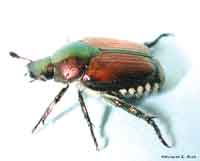
japanese_beetle_adult.jpg I always thought that Japanese beetle infestations were at their worst in July. Why then, are they suddenly attacking some of my roses in August?

I’ve luckily never had too much trouble with Japanese beetles. Only a few here and there each year, whereas I hear from some gardeners that their roses and other plants are partially destroyed after a heavy infestation of the dreaded Japanese Beetles.

These nasty bugs only seem to be attacking a few of my roses. They love my Morden Sunrise in my front flower bed, and in the backyard they seem to be attacking William Baffin, Jacques Cartier, Climbing Iceberg, Baronne Prevost and Compte de Chambord. Considering how many roses I grow that’s not too bad, however these are some of my biggest roses so the damage is stating to become quite visible.

If your garden has never been attacked by Japanese beetles consider yourself lucky.

Adult Japanese beetles are 3/8 inch long metallic green beetles with hard, copper-brown wing covers. Five small white tufts project from under the wing covers on each side, and a sixth pair at the tip of the abdomen. These white tufts help to distinguish them from similar metallic green or coppery colored beetles.

Adults emerge from the ground in late May or early June. Individual beetles live about 30 to 45 days with activity concentrated over a four to six week period. Beetle numbers begin to decline in late July but some can be found as late as September.

I wonder if our cool June and rainy wet July delayed their emergence here in the Toronto area?

Japanese beetles can feed on about 300 species of plants, ranging from roses to poison ivy. Odor and location in direct sun seem to be very important factors in plant selection. The beetles usually feed in groups, starting at the top of a plant and working downward. While a single beetle doesn’t eat much; group feeding by many causes severe damage. Adults feed on the upper surface of foliage, chewing out tissue between the veins. This gives the leaf a characteristic skeletonized appearance.

I’ve also found that Japanese beetles seem to like eating rose buds and newly blooming roses.

If you don’t have too heavy an infestation of Japanese Beetles I’ve found that the best way of controlling them seems to be literally picking them off the plants and dropping them into a bucket of soapy water where they will drown.

The application of Milky Spore to the soil each year will also eventually kill off the larvae and make the likelihood of an infestation much lower.

There are pesticides that you can use if you have a heavy infestation in your garden. I prefer not to use chemicals in my garden because they often do more damage than good. I garden organically and I’ve found that dealing with pests can be quite challenging in an organic garden. I’m glad that there are always alternatives to using chemicals.

Traps can be used to attract and collect beetles however research conducted at the University of Kentucky has shown that the traps attract many more beetles than are actually caught. Consequently, susceptible plants along the flight path of the beetles and in the vicinity of traps are likely to suffer much more damage than if no traps are used at all. In most landscape situations, use of Japanese beetle traps probably will do more harm than good. If you experiment with traps, be sure to place them well away from gardens and landscape plants.

In previous years I’ve grown Four O’Clocks (Marvel of Peru) beside several of my rose bushes and it’s said that Japanese beetles do not like this plant. Perhaps that’s why I’ve never had much trouble with the darn shiny bugs. I planted my Four O’clock seeds late this year though so the plants likely aren’t mature enough to discourage the beetles.

I also used to grow garlic near my roses as that was said to help ward off Japanese beetles. I don’t grow garlic anymore as I always forgot to pick it!

Have your plants ever been attacked by Japanese Beetles? Have you seen any Japanese beetles this year? How have you handled beetle infestations?

Filed Under: Garden Maintenance, Garden Tips, Living Green, Organic, pests, Summer in the Garden, Toronto Tagged With: activity, alternatives to chemicals, attacking plants, august, beetle, beetle traps, bucket of soapy water, damage, damaged roses, eat leaves, eating roses, emergence, flower, garden organically, grow four oclocks, grow garlic, hand pick, hand pick beetles from plants, infestation, infestations, Japanese Beetles, landscape, location, milky spore, Odor, organic garden, pesticides, Poison, rainy, roses, shiny beetles, skeletonized leaves, soapy water, tip, Toronto, traps, ward off beetles

  • « Previous Page
  • 1
  • 2
  • 3
  • 4
  • …
  • 8
  • Next Page »

Subscribe


Never miss a post
Subscribe to our RSS feed!
It's FREE! rss feed

Free Newsletter

As the Garden Grows
by Email - FREE!


Follow me on Twitter!

Suggested Sites

Eavestrough Cleaning Toronto

Categories

Recent Posts

  • Top Three Tips For Choosing The Right Patio Furniture For Your Home
  • The 4 Things To Know About Perennial Garden Design
  • Painful Plants: Five Houseplants That Can Cause Injury
  • An Outbreak Shouldn’t Mean A Break Out: 3 Insect Repellants Gentle Enough For Your Skin
  • 5 Ideas To Make Your Garden POP
  • 6 Simple Ways To Make Your Home Eco-Friendly
  • How To Redesign Your Garden To Make It Safe For Your Children
  • Starting A Career As A Professional Gardener
  • 6 Time Saving Tips For Gardening
  • Top Tips On Redesigning Your Garden For The Summer

What they’re Saying

  • Rodhe Stevens on Landscaping Tips On A Limited Budget
  • Edmund Wells on Benefits of using mulch on the garden
  • Surjith on An Outbreak Shouldn’t Mean A Break Out: 3 Insect Repellants Gentle Enough For Your Skin
  • Pamela on The 4 Things To Know About Perennial Garden Design
  • dog on The quality of your pet food is important

Pages

  • About
  • Archives
  • Become a Guest Blogger For As the Garden Grows
  • Blog
  • Categories
  • Contact
  • Disclosure
  • Do Follow Bloggers Blogroll
  • Green Thumb Sunday
  • I am Canadian Blogroll
  • Join GTS Meme
  • Links
  • Privacy Policy
  • Q & A
  • Toronto Bloggers Blogroll
  • What’s Growing

Search

My Garden

Member of
Garden Voices

Tags

backyard Beautiful bloom blooming blooms Bulbs cold Entertainment and Rec flower flowers garden garden bed garden beds gardener gardening green Green Thumb Green Thumb Sunday grow growing GTS home Home and Lifestyle House In The Garden leaves my garden photo photos plant plants purchase rain rose roses Shopping snow spring summer Toronto water weather winter Wordless Wednesday WW

Site Ratings


Visitors since 2006


Meta

  • Log in
  • Entries feed
  • Comments feed
  • WordPress.org

Connect with me

  • Facebook
  • Google Plus
  • Pintrest
  • Twitter
  • RSS

Copyright © 2026 · News Child Theme on Genesis Framework · WordPress · Log in