As the Garden Grows

What's blooming today?

  • Home
  • Blog
  • Archives
  • Links
  • About
  • Join GTS Meme
  • Guest Blogger
  • Contact

You are here: Home / Archives for traps

Damage to Lawns and Gardens Caused by Moles and Voles

by Trish

We are most familiar with moles, which are mouse-like creatures that can do so much damage to your lawn. What about voles? Well, their names might sound alike, and voles are also often mistaken for moles. These creatures, however, are different from each other. Whereas voles are rodents, moles are not. They also have different characteristics and food preferences. But both animals can wreak havoc to your garden and lawns.

The Mole – How It Destroys Grounds

Moles are insectivorous. This means that they won’t eat your precious tulip bulbs. Instead, they’ll feed on insect larvae, grubs, and earthworms. So, how do they cause damage to your yard? It is seldom to see moles crawling on the grass. They are always underneath the ground. These creatures create tunnels that they use to get to food sources. Oftentimes, moles create berms or mounded hills when forming their runways. So, while going on their merry way in search for their favorite worms, they also spoil your lawn.

The Vole and the Damage It Causes

Unlike moles, voles are vegetarians. They target seeds, bulbs, and roots. When food is scarce, such as during winter time, it’s also pretty common for voles to eat shrubs and tree bark. Because they like plants, they can cause considerable damage to gardens. Your prized plants are surely not safe if there are voles around. Just imagine all of your hard work going down the drain once voles start snacking on your precious dahlias or your succulent tomatoes. Won’t that make you feel really frustrated?

Voles can make tunnels if they need to. However, they often choose the easy way, and that is exploiting the tunnels that have been created by moles. In case they choose to build underground runways, they do not create berms. Nevertheless, they produce damage under the ground, which could also weaken the integrity of the top soil.

Keeping Out Moles and Voles

Voles

1. Keep grounds well-maintained.

Voles are attracted to lush vegetation, and they grow particularly emboldened when there are tall grasses or deep mulch that keeps them hidden. So, one way to discourage these critters is by ensuring that your lawn is maintained well. Mow grass regularly, and get rid of weeds. When putting mulch, keep the layer thin and not too deep.

2. Wrap tree trunks in metal wires.

Because voles eat bark, it’s best to protect the base of trees. Get some metal wires or mesh wires and put these around the bark of trees. Also, keep mulch and dense vegetation away from the base of trees.

3. Use traps and other methods to eradicate voles.

You can use humane mice traps to catch voles. There are also poisons and other substances that can be used to repel or kill voles.

Moles

1. Control the insect population in your garden.

Since moles are attracted to all sorts of worms and insects, be sure to keep the insect population in your lawn under control. By keeping their food sources scarce, they won’t be encouraged to live in your lawn or to go back to your garden every time they’re hungry.

2. Utilize traps to capture moles.

There are all sorts of traps that you can use, such as harpoon, scissors or choker mole traps. If you prefer a more humane way to get rid of moles, check out the Havahart traps, which are live trapping devices. But you have to be find a place far from your property where you can release the animal you’ve trapped.

Final Note

Critters pose a problem and a challenge to most homeowners. If you want to get rid of pests but you don’t know how, consult a professional. Experts will suggest what sort of methods you can use. They can also propose eco-friendly and safer options so that you won’t have to expose yourself, your kids and your pets to dangerous chemicals.

Attached Images:
  •  License: Creative Commons – Hackworth. “Bloody moles! 3 September 2007”. September 3, 2007. Online image. Flickr. December 5, 2012. image source

Claire Lassiter is a freelance writer who frequently blogs about pest management. She covers many topics, including rodents, roaches, stinging pests, and other damaging bugs. She provides material for Rove Pest Control, a company that specializes in eradicating several kinds of destructive pests.


Filed Under: Garden Maintenance, In The Garden, pests Tagged With: creatures, cut grass, damage, eat plants, garden, havoc, hills, insects, lawn, maintain, moles, mouse, traps, tunnels, underground, voles

Japanese Beetles damaging the garden

by Tricia

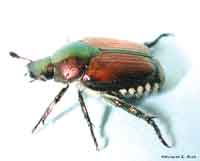
japanese_beetle_adult.jpg I always thought that Japanese beetle infestations were at their worst in July. Why then, are they suddenly attacking some of my roses in August?

I’ve luckily never had too much trouble with Japanese beetles. Only a few here and there each year, whereas I hear from some gardeners that their roses and other plants are partially destroyed after a heavy infestation of the dreaded Japanese Beetles.

These nasty bugs only seem to be attacking a few of my roses. They love my Morden Sunrise in my front flower bed, and in the backyard they seem to be attacking William Baffin, Jacques Cartier, Climbing Iceberg, Baronne Prevost and Compte de Chambord. Considering how many roses I grow that’s not too bad, however these are some of my biggest roses so the damage is stating to become quite visible.

If your garden has never been attacked by Japanese beetles consider yourself lucky.

Adult Japanese beetles are 3/8 inch long metallic green beetles with hard, copper-brown wing covers. Five small white tufts project from under the wing covers on each side, and a sixth pair at the tip of the abdomen. These white tufts help to distinguish them from similar metallic green or coppery colored beetles.

Adults emerge from the ground in late May or early June. Individual beetles live about 30 to 45 days with activity concentrated over a four to six week period. Beetle numbers begin to decline in late July but some can be found as late as September.

I wonder if our cool June and rainy wet July delayed their emergence here in the Toronto area?

Japanese beetles can feed on about 300 species of plants, ranging from roses to poison ivy. Odor and location in direct sun seem to be very important factors in plant selection. The beetles usually feed in groups, starting at the top of a plant and working downward. While a single beetle doesn’t eat much; group feeding by many causes severe damage. Adults feed on the upper surface of foliage, chewing out tissue between the veins. This gives the leaf a characteristic skeletonized appearance.

I’ve also found that Japanese beetles seem to like eating rose buds and newly blooming roses.

If you don’t have too heavy an infestation of Japanese Beetles I’ve found that the best way of controlling them seems to be literally picking them off the plants and dropping them into a bucket of soapy water where they will drown.

The application of Milky Spore to the soil each year will also eventually kill off the larvae and make the likelihood of an infestation much lower.

There are pesticides that you can use if you have a heavy infestation in your garden. I prefer not to use chemicals in my garden because they often do more damage than good. I garden organically and I’ve found that dealing with pests can be quite challenging in an organic garden. I’m glad that there are always alternatives to using chemicals.

Traps can be used to attract and collect beetles however research conducted at the University of Kentucky has shown that the traps attract many more beetles than are actually caught. Consequently, susceptible plants along the flight path of the beetles and in the vicinity of traps are likely to suffer much more damage than if no traps are used at all. In most landscape situations, use of Japanese beetle traps probably will do more harm than good. If you experiment with traps, be sure to place them well away from gardens and landscape plants.

In previous years I’ve grown Four O’Clocks (Marvel of Peru) beside several of my rose bushes and it’s said that Japanese beetles do not like this plant. Perhaps that’s why I’ve never had much trouble with the darn shiny bugs. I planted my Four O’clock seeds late this year though so the plants likely aren’t mature enough to discourage the beetles.

I also used to grow garlic near my roses as that was said to help ward off Japanese beetles. I don’t grow garlic anymore as I always forgot to pick it!

Have your plants ever been attacked by Japanese Beetles? Have you seen any Japanese beetles this year? How have you handled beetle infestations?

Filed Under: Garden Maintenance, Garden Tips, Living Green, Organic, pests, Summer in the Garden, Toronto Tagged With: activity, alternatives to chemicals, attacking plants, august, beetle, beetle traps, bucket of soapy water, damage, damaged roses, eat leaves, eating roses, emergence, flower, garden organically, grow four oclocks, grow garlic, hand pick, hand pick beetles from plants, infestation, infestations, Japanese Beetles, landscape, location, milky spore, Odor, organic garden, pesticides, Poison, rainy, roses, shiny beetles, skeletonized leaves, soapy water, tip, Toronto, traps, ward off beetles


Subscribe


Never miss a post
Subscribe to our RSS feed!
It's FREE! rss feed

Free Newsletter

As the Garden Grows
by Email - FREE!


Follow me on Twitter!

Suggested Sites

Eavestrough Cleaning Toronto

Categories

Recent Posts

  • Top Three Tips For Choosing The Right Patio Furniture For Your Home
  • The 4 Things To Know About Perennial Garden Design
  • Painful Plants: Five Houseplants That Can Cause Injury
  • An Outbreak Shouldn’t Mean A Break Out: 3 Insect Repellants Gentle Enough For Your Skin
  • 5 Ideas To Make Your Garden POP
  • 6 Simple Ways To Make Your Home Eco-Friendly
  • How To Redesign Your Garden To Make It Safe For Your Children
  • Starting A Career As A Professional Gardener
  • 6 Time Saving Tips For Gardening
  • Top Tips On Redesigning Your Garden For The Summer

What they’re Saying

  • Rodhe Stevens on Landscaping Tips On A Limited Budget
  • Edmund Wells on Benefits of using mulch on the garden
  • Surjith on An Outbreak Shouldn’t Mean A Break Out: 3 Insect Repellants Gentle Enough For Your Skin
  • Pamela on The 4 Things To Know About Perennial Garden Design
  • dog on The quality of your pet food is important

Pages

  • About
  • Archives
  • Become a Guest Blogger For As the Garden Grows
  • Blog
  • Categories
  • Contact
  • Disclosure
  • Do Follow Bloggers Blogroll
  • Green Thumb Sunday
  • I am Canadian Blogroll
  • Join GTS Meme
  • Links
  • Privacy Policy
  • Q & A
  • Toronto Bloggers Blogroll
  • What’s Growing

Search

My Garden

Member of
Garden Voices

Tags

backyard Beautiful bloom blooming blooms Bulbs cold Entertainment and Rec flower flowers garden garden bed garden beds gardener gardening green Green Thumb Green Thumb Sunday grow growing GTS home Home and Lifestyle House In The Garden leaves my garden photo photos plant plants purchase rain rose roses Shopping snow spring summer Toronto water weather winter Wordless Wednesday WW

Site Ratings


Visitors since 2006


Meta

  • Log in
  • Entries feed
  • Comments feed
  • WordPress.org

Connect with me

  • Facebook
  • Google Plus
  • Pintrest
  • Twitter
  • RSS

Copyright © 2026 · News Child Theme on Genesis Framework · WordPress · Log in