• Entertainment
  • Musicians
  • Recreation
  • Guitars
  • Playing Styles

Guitar Licks

Guitars, tips and great music discussions

  • Home
  • Blog
  • Archives
  • Links
  • About
  • Guest Blogger
  • Contact


You are here: Home / Archives for pickups

OMG you gotta hear it to believe it

October 4, 2007 by Chris

Now I already have a good pick-up system in my Larrivee L-03 but when went into my favorite guitar store, the 12th Fret in Toronto, I feel madly in love with the L.R. Baggs IMix.

Now I have been looking to update my pick-up system in my L0-3 lately and found many systems in which to chose from. I have narrowed it down to two items. (1) the Fishman Ellipse Blend vs. (2) the LR Baggs IMix.

When I went in I talked to my favorite guitar guy Tim Cameron. Being the honest guy that he is he immediately directed me to a acoustic guitar pick up god named Nevin. I told him what I was looking for and told him that I was just looking to hear the differences between the two and he paid as much attention to me as if I was going to pick one up right then and there, now that’s service!

He brought me two guitars that had the pick-up systems already in them and put me in their little music room, plugged me in and let me got at them. Wow, was I impressed with both!

First I tried the Fishman Ellipse Blend. It had a real nice sound but I was detecting feed back. I know that I was in a little room but for some reason the feeling and sound was off to me. I realize I am knew at the finer subtleties of acoustic pick ups, but it was a gut feeling. It was very refreshing to see that you can adjust the position of the mic inside.

Then I tried the LR Baggs iMIX. The sound was full, responsive to very fine picking and it can overpower your senses, in my view that is.
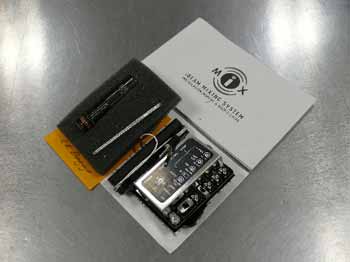
imix.jpg

Guitarist realize that since the sound of the acoustic guitar is very complex and fickle, so therefore it is a must to use more than a single pickup to attempt to sense it.

The iMIX uses the Baggs iBeam under-bridge pickup with a Baggs Element under-saddle piezo. The Element pickup senses the strings and provides the presence and feedback resistance of piezo while the iBeam reads the sound inside the guitar and adds natural fidelity, albeit with increased feedback sensitivity. The signals from the the two pickups are blended, in this case via the rotary blend control, on a side-mounted, Baggs iMIX Onboard, pre-amp. This pre-amp also features three slider controls for volume, treble and bass, plus a phase reverse switch for a measure of elementary feedback control. A fingertip pressure releases the battery from its compartment for a quick change when required.

iBeam
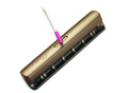
ibeam.jpg

Element

element.jpg

Now all that I have to do is get my wife on board!

Keep on Jammin’


Filed Under: Guitar Equipment, Guitars, My Equipment Tagged With: 12th Fret, acoustic guitar, acoustic pick ups, adjust, amp, bass, element, Fishman Ellipse Blend, fret, guitar pick, guitarist, guitars, ibeam, Larrivee, Larrivee L 03 guitar, LR Baggs IMIX, Music, pickups, sound, strings, Toronto

More on my 1959 Fender Duo Sonic

August 30, 2007 by Chris

This baby was first introduced to us in mid 1956, the original Duosonic (two pickups) were Fender’s 3/4 size, student model, 22.5″ short scale beginners guitars.

With the switch in the middle position, the two pickups are in series, giving a humbucking pickup type sound. These short scale student models were made to the same high quality standards and materials that Fender used for its more expensive models. For this reason, Duo-Sonics are very well made.

In late 1964 both models moved to second generation, coinciding with the introduction of the Mustang. A buddy of mind, Serge Roy of Brantford has one of these puppies! The “II” designation was then added to the DuoSonic and MusicMaster names. These models are more like the Mustang (except the Mustang has a vibrato), than the original DuoSonic/MusicMaster models. The differences in the new generation were in the body shape, pickguard, and electronics.

It was available with either a 22.5″ or 24″ scale, but is most often found with the longer scale. The 24″ scale Duo-Sonic II, Musicmaster II, and Mustang of the September 1965 to October 1966 period are sometimes found with a slab rosewood fingerboard, usually of Indian rosewood.

Some Fender experts today speculate that the slab board necks were leftovers from 1962 Jaguars. Don’t tell Serge about this one,ok?

No matter what is said about this vintage instrument the only thing that matters is how it plays and sounds. I am truly blessed by having this little gem of a guitar and I know that. If you ever get the opportunity to play a 1959 Fender Duo Sonic you will know what I mean and remember this post!

Keep on Jammin’

Filed Under: Guitar Equipment, Guitars, My Equipment, My experiences Tagged With: 1959 Fender Duo Sonic, body shape, duo sonic, Electronics, fender, fingerboard, guitar, guitars, humbucking pickup sound, Indian rosewood, instrument, longer scale, Music, Musicmaster specs, MusicMasters, Mustang, pickguard, pickups, play, plays, rosewood, sound, sounds, student model, vintage, Vintage 1959 Fender Duosonic, vintage Fender Guitars

My 1979 Gibson RD-Artist

December 22, 2006 by Chris

Wow, is all that I have to say about this baby! It has a rounded like Gibson Explorer or Firebird body that is as heavy as a tank, seriously, come over and lift the thing! It has the wide neck with 22 frets that I love and has a great straight forward sound. It was one of the original guitars that had built in compression in it, oooooooohhh! When I got the balls as a high school kid, I took off the plastic cover that exposed it’s internal workings. It looked to me as the internal workings of a space ship. Opps, better not touch anything in there!

So my parents bought this guitar at Steve’s Music in Toronto. With me in tow, I tried out many guitars after getting over how many axes there was in this place. It was a toss up really between the RD and a Gibson ES-335, which is comparable to to RD if you read the WHOLE article below. I think that the main reason that I bought the RD was because it looked REALLY COOL! It still does.

Now for some boring technical reading, everyone comfortable yet?

Some time ago when the Gibson M-III was introduced to much fanfare, a lot of people could be overheard expressing awe at the possibilities of the switching system. But, as we’ve seen, this is only the latest example of Gibson’s long infatuation with complex switches. While the Les Paul Recording remains my personal favorite, it’s followed quickly by the often insulted RD Artist, occasionally referred to as the “Research & Development” Artist.

The RD line was originally conceived in 1975, officially introduced in 1977 and ultimately discontinued in 1982. The RD series was essentially Gibson’s response to the emerging success of companies like Alembic and B.C. Rich, which specialized in lots of switches with fancy electronic options. It’s curious to note that a Norlin subsidiary, the distributor L.D. Heater, of Portland, OR, handled B.C. Rich as well as Gibson guitars in the early ’70s. Early B.C. Riches used Gibson humbuckers obtained through L.D. Heater until Gibson found out. B.C. Rich switched to Guild and then DiMarzio pickups and took over its own distribution shortly thereafter. Maybe the RD was Gibson’s revenge?…

To execute this design, Gibson employed Robert Moog, of Moog synthesizer fame, and the man behind the last mach of the Gibson Maestro effects of that very same era.

The RD series was, admittedly, a little demented. First of all, its shape is sort of a retread Reverse Firebird, maybe the offspring of mating with a Guild Thunderbird (one which unfortunately didn’t inherit the built-in stand!). The maple body is comfortably contoured, though, and the neck solidly glued on for an overall pretty nice feeling guitar, sort of like an SG. Put a pillowcase over the body and you can get down with this baby.

The RD Artist was the top-of-the-line, with an unbound ebony fingerboard (the catalog said bound ‘board, but most if not all were not bound), block inlays, gold hardware, fancy bound pearl inlaid headstock and more comprehensive active features activated by a second large toggle switch. Pickups were two Gibson Series VI humbuckers with a threeway select, two volume controls, individual treble and bass tone controls, and a built-in preamp circuit with compression/expansion and bright/lead functions.

Unfortunately, Moog and Gibson didn’t just settle for a simple preamp switch like the B.C. Rich. Instead, we get another complex switching system on the Artist models. Here’s the skinny; bear with me.

The threeway pickup select and individual treble and bass tone controls are pretty clear and a very nice feature on any guitar. In the center position, the second threeway toggle switch is in neutral, making the guitar active but without the special circuits. In the forward position, the switch activates a bright/lead function which accentuates the treble frequencies. This works for both pickups.

In the back position, the active switch turns on a compression/expansion circuit. The compression function operates on the neck pickup only and reduces the fundamental attack time and “compresses” each note into a longer sustaining signal. In this mode, the output remains stable no matter how hard you play.

The expansion function (we haven’t moved the second toggle yet) operates on the bridge pickup only and “permits the player to play harder and louder without the note collapsing. Expansion offers a very fast, explosive response with a rapid decay,” says the Gibson literature.

Of course, either function works in the middle pickup selector position, too.

To read the full article go to Vintage Guitar Magazine and, look 1/2 way down the page. I too have just learned something as well!

Filed Under: Guitar Equipment, Guitars, My Equipment Tagged With: cool, fingerboard, fret, functions, guitar, guitars, heavy, learn, Music, pickups, RD Artist, sound, vintage

Connect with Us

  • RSS

Suggested Sites


Eavestrough Cleaning Toronto

Categories

Recent Posts

  • 5 Amazing Alternative Rock Albums Of The 90s
  • Want To Learn To Be A Musician?
  • How Can Ambitious Musicians Find Great Advice From Professionals?
  • Which Musical Instruments Are Hardest To Learn?
  • Things To Know When Beginning A Career In Music
  • Suicidal Tendencies Still Rocking After All These Years
  • Learning Guitar Basics Online

Recent Comments

  • Judy Green on The Old Gasworks was a Toronto institution for music lovers and bands
  • Frank Bolduc on The Old Gasworks was a Toronto institution for music lovers and bands
  • Tom Farr on 5 Amazing Alternative Rock Albums Of The 90s
  • DW on 5 Amazing Alternative Rock Albums Of The 90s
  • Nick Othen on 5 Famous People And Their Guitars

Subscribe

Never miss a post
FREE - Subscribe NOW!
Read our posts in your favorite RSS reader.
rss feed

OR

Subscribe to Guitar Licks by FREE Email Newsletter


Follow us on TWITTER!

Alltop, confirmation that I kick ass
Alltop Guitar news

Shopping

Gifts, Gadgets,
Books and More!

Site Ratings

Visitors


Meta

  • Log in
  • Entries feed
  • Comments feed
  • WordPress.org

Archives

Search

Pages

  • About
  • Archives
  • Become a Guest Blogger for Guest Licks
  • Blog
  • Canadian Bloggers
  • Contact
  • Disclosure
  • Do Follow Bloggers
  • Links
  • Privacy Policy
  • Toronto Bloggers

Blogroll

  • Guitar Boomer
  • Eavestrough Cleaning Toronto
  • Guitar-Werks

My Store

  • My Store

Other Sites

  • Celebrity Scoop 2
  • Tricia's Musings
  • WebStyle
  • Home And Garden Diva
  • Shopping Maniac

Tags

Acoustic amp band bands Brantford Bruce Cockburn Canada Canadian concert Entertainment fender funny General guitar Guitar Equipment guitarist guitar player guitars Home house Humor humour instrument jammin jazz John Mayer keyboard Live Music musician Musicians play playing Progressive Rock Pylis rock RUSH Songs to play sound strings Technology Toronto tour Video YES

Copyright © 2026 · News Pro Theme on Genesis Framework · WordPress · Log in