As the Garden Grows

What's blooming today?

  • Home
  • Blog
  • Archives
  • Links
  • About
  • Join GTS Meme
  • Guest Blogger
  • Contact

You are here: Home / Archives for In The Garden / Garden Tips

Obtaining Annuals and Perennials for your garden

by Tricia

When you are first establishing a perennial garden you will probably buy all of your plants from a nursery, garden center or an online mail order gardening company. However, one of the great advantages of perennials is their ease of propagation. By the end of the first season you will have quite a few large plants ready for dividing.

I’ve divided my Hostas, Rudbeckia (Daisies), heuchera and astilbes several times. Some perennials, such as peonies, will grow for many years without needing to be divided. Some, such as peonies, will grow for many years without needing to be divided, and may not recover quickly once broken up, but to maintain their vigor most perennials need dividing at least every three years.

Many perennials can also be grown from cuttings, usually of the fast growing spring shoots.

Annuals must be raised from seed. You can do this for yourself or buy ready to plant seedlings from a garden center. I’ve found that by growing several of my annuals from seed I tend to have access to a wider variety of types of annuals and or colours as opposed to the offerings at most garden centers and nurseries which tend to sell the most popular varieties of annuals.

For small quantities, raising your own seed is seldom cheaper than buying seedlings, but if you have large beds to plant out, raising your own plants often represents a considerable saving.

Seed sowing and germination are usually fairly straight forward. In many cases the seeds may be sown directly where the plant is to grow in the garden bed. Some annuals need to be started in late winter or very early spring indoors in order to be large enough to plant out come late spring or early summer.

Most perennials and bulbs are planted in early autumn or early to mid-spring, whereas annuals are often started indoors in February or March and planted as seedlings from mid-May through June; or purchased as seedlings in late April and May and planted out after the last frost.

Enjoy your lovely garden.


Filed Under: Garden Buzz, Garden Maintenance, Garden Tips, In The Garden, Perennials, Plant Profiles, Spring Tasks Tagged With: Annuals, astilbe, autumn, Bulbs, daisies, dividing, garden bed, garden center, Garden Tips, germinate, grow from seed, heuchera, hota, indoors, late winter, nursery, obtaining plants, online mail order, peonies, Perennials, planting, propagation, rudbeckia, seedling, seeds, sow, sowing, spring

It’s time to plant Spring Bulbs

by Tricia

Have you planted your Spring Bulbs Yet?

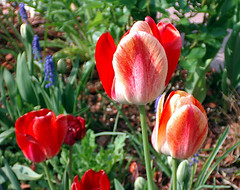
Spring Tulips Bulbs are easy to grow and are a wonderful choice for the garden. They take up little space and provide a burst of color at a time when your border, or garden, can be flagging.
Firstly ensure that the bulbs that you purchase are healthy and free of disease. Avoid misshapen bulbs, any that look dry and withered or with areas of mold showing. These will not grow, but, worse, they also have the potential to spread disease to your existing bulbs.

If you are buying for container planting, large bulbs will produce more flowers. Smaller bulbs are perfectly fine for mass planting in the border.

Many smaller bulbs such as fritillaria are also more successful when bought in containers- always check that these moisture loving and other woodland bulbs have not dried out when buying.

Most bulbs come from the Mediterranean regions and enjoy free-draining, sunny positions. Some woodland bulbs do not. Erythronium (Dog’s Tooth Violets), Trilliums, Anemone nemerosa, Galanthus (Swnodrops) and the popular Arisaemas all need humus rich soil and cooler, shadier conditions.

Spring flowering bulbs are planted in autumn, autumn flowering bulbs are planted in spring. The planting technique is similar.

Narcissi should be planted by the end of March. You can plant later but the flowers will not be as prolific as the bulbs will have started into premature growth. Tulips can be planted a month later. Containers of bulbs can be planted later than bulbs in the ground as containers tend to warm earlier and the bulbs come into flower before those in the ground.

Plant mail-order bulbs of pot them straight away. Don’t try to keep them dry for long periods.

Preparing to Plant
Prepare the border by digging in some well-rotted compost or adding a fertilizer such as blood and bone. Do not plant bulbs directly on top of fresh manures or partially rotted compost- the decomposition of these materials may well affect and infect your bulbs.

Make the planting hole about twice the depth of the recommended planting depth, then fill to the required level. This gives a good, fertile and friable soil for the bulb roots to grow into and you will see a measurable difference in the flowers.

Sand or grit at the base of the planting hole improves drainage, especially on heavy, clay soils, and can deter some bulb-feeding pests.

Clumps of bulbs, planted three, five or seven to a generous planting hole (don’t crowd them) look more natural than serried rows. It all depends on the look that you want.

Formal planting needs to be carefully done, using a line or wooden marker to keep lines straight. Organize you bulbs so that you don’t muddle them – a bright yellow tulip in the midst of a pink scheme screams mistake.

Mulching bulbs helps stop soil temperature fluctuations and unseasonable bursts of growth.

Planting Depths
Planting at the right depth provides the right conditions for your bulbs- too shallow and they may suffer from summer height or winter frosts.

As a rough rule of thumb bulbs should be planted at a depth equivalent to three to four times the height of the bulb. On lighter, sandy soils, go even deeper.

Filed Under: Bulbs, Garden Tips, Home and Lifestyle, Shopping Tagged With: Bulbs, Garden Tips, Home and Lifestyle, plant spring bulbs in Autumn, planting bulbs, preparing to plant bulbs, Shopping, spring bulbs

Summer Passion

by Tricia

Join Green Thumb Sunday
Join
Summers fading quickly here. Is it starting to cool down in your part of the world?

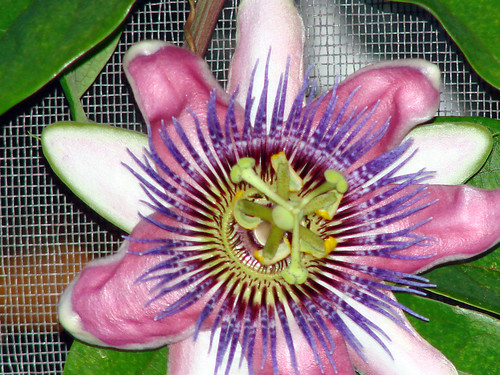
Passion flower

A passion flower to remind us of the hottest days of summer.

This passion flower is Passiflora x belotii, it’s growing in a pot outside in my garden. It’s grown so much that it’s now climbing onto my enclosed back porches screened windows.

Passiflora x belotii is a hybrid of P. alata x P. caerulea. Named P. alato-caerulea by Dr Lindley in 1824, John Vanderplank’s book lists the following alternative names, P. x belotii, P. ‘Empress Eugenie’, P. ‘Imperatrice Eugenie’, P. ‘Kaiserin Eugenia’, P. munroi & P. x pfortii, some of which are still in use. The latest Passiflora Hybrid Lists have collapsed them all into ‘P. x belotii’.

Flower variations however include either a dark or light centre, one or a number of white bands on the coronal filaments & petals crumpled to varying degrees. Clearly there are a number of similar but distinct hybrids, probably all of P. alata x P. caerulea parentage.

Passion flowers are plants that grow as vines. This particular type can grow 20 to 30 feet. Mine is currently in the 20 foot range. They are hardy from USDA zones 7a to 10b. They thrive in sun to partial shade (bright shade, not dark shade).

Parts of the plant are dangerous if ingested, in fact the leaves give off a form of cyanide when crushed.

The blooms are pink to violet/ Lavender and the foliage has a shiny glossy texture. The blooms can be mildly fragrant. My blooms have a slight sweet candy like scent. Water regularly, this plant likes its soil moist but not damp. A well draining soil is needed for this plant.

This plant can be propagated from From softwood cuttings, semi-hardwood cuttings, simple layering, and by air layering. Seeds can be collected from ripened fruit and the plant can then be grown from seed.

I need to bring this plant indoors in the winter time as it is not hardy to my climate. I keep it in a brightly lit room and water it regularly to keep the soil slightly moist. It can be susceptible to spider mites and white fly so if you must also bring your passion flower indoors please try to keep the humidity up inside the house or the room in which the plant is housed. Occasionally misting the leaves and stems will help as well. It’s not uncommon for some of the leaves to drop off when brought indoors in the early fall. The plant will acclimate itself to your homes environment in a short while and will start to look healthy again if you care for it properly.

Gardeners, Plant and Nature lovers can join in every Sunday, visit As the Garden Grows for more information.

Filed Under: Garden Tips, Green Thumb Sunday, Home and Lifestyle, Perennials, Plant health, Recreation Tagged With: care of the passion flower, Entertainment and Rec, Garden Tips, Green Thumb Sunday, Home and Lifestyle, Passiflora x belotii, passion flower, Perennials, Plant health

  • « Previous Page
  • 1
  • …
  • 32
  • 33
  • 34
  • 35
  • 36
  • Next Page »

Subscribe


Never miss a post
Subscribe to our RSS feed!
It's FREE! rss feed

Free Newsletter

As the Garden Grows
by Email - FREE!


Follow me on Twitter!

Suggested Sites

Eavestrough Cleaning Toronto

Categories

Recent Posts

  • Top Three Tips For Choosing The Right Patio Furniture For Your Home
  • The 4 Things To Know About Perennial Garden Design
  • Painful Plants: Five Houseplants That Can Cause Injury
  • An Outbreak Shouldn’t Mean A Break Out: 3 Insect Repellants Gentle Enough For Your Skin
  • 5 Ideas To Make Your Garden POP
  • 6 Simple Ways To Make Your Home Eco-Friendly
  • How To Redesign Your Garden To Make It Safe For Your Children
  • Starting A Career As A Professional Gardener
  • 6 Time Saving Tips For Gardening
  • Top Tips On Redesigning Your Garden For The Summer

What they’re Saying

  • Rodhe Stevens on Landscaping Tips On A Limited Budget
  • Edmund Wells on Benefits of using mulch on the garden
  • Surjith on An Outbreak Shouldn’t Mean A Break Out: 3 Insect Repellants Gentle Enough For Your Skin
  • Pamela on The 4 Things To Know About Perennial Garden Design
  • dog on The quality of your pet food is important

Pages

  • About
  • Archives
  • Become a Guest Blogger For As the Garden Grows
  • Blog
  • Categories
  • Contact
  • Disclosure
  • Do Follow Bloggers Blogroll
  • Green Thumb Sunday
  • I am Canadian Blogroll
  • Join GTS Meme
  • Links
  • Privacy Policy
  • Q & A
  • Toronto Bloggers Blogroll
  • What’s Growing

Search

My Garden

Member of
Garden Voices

Tags

backyard Beautiful bloom blooming blooms Bulbs cold Entertainment and Rec flower flowers garden garden bed garden beds gardener gardening green Green Thumb Green Thumb Sunday grow growing GTS home Home and Lifestyle House In The Garden leaves my garden photo photos plant plants purchase rain rose roses Shopping snow spring summer Toronto water weather winter Wordless Wednesday WW

Site Ratings


Visitors since 2006


Meta

  • Log in
  • Entries feed
  • Comments feed
  • WordPress.org

Connect with me

  • Facebook
  • Google Plus
  • Pintrest
  • Twitter
  • RSS

Copyright © 2026 · News Child Theme on Genesis Framework · WordPress · Log in